 Gabri
Gabri
A triggerbot is cheat software that fires your weapon the instant your crosshair lands on an enemy. It doesn't aim for you.
You move the crosshair, and the triggerbot pulls the trigger faster than your finger can.
Riot's June 2026 anti-cheat update describes the screen-reading cheats it calls pixelbots "sometimes just simply pulling the trigger for the cheater when an enemy enters their reticle," and says that's what a triggerbot is. The same update puts cheaters in about 0.7% of all PC ranked matches across League of Legends and Valorant.
There are two ways a triggerbot decides when to fire, and both leave a trail.
On October 12, 2026, I read what Riot, EA and BattlEye say about catching them, and what happens to the players they catch.
Already hit with a ban on the PC itself, not only the account? Jump to the HWID spoofer section. If you're here to understand triggerbots or spot one in your lobby, Saturn isn't your answer, so read straight through.
How Does a Triggerbot Work?
A triggerbot works by asking one question many times a second: is an enemy under the crosshair right now? When the answer is yes, it sends a click.
Every trigger bot is a different way of answering that question.
Some read the picture on your screen, the same pixels you see, while others read the game's memory, where the game keeps track of exactly what sits under your crosshair at every moment.
| Type | How it knows when to fire | Where it tends to get caught |
|---|---|---|
| Screen-reading (pixelbot) | Enemy outline colors in the middle of the screen | The click it sends and the match data |
| Memory-reading | The game's own data on the target | The anti-cheat on your PC |
| Part of a cheat menu | The same target data as the aimbot or ESP | Whatever catches the main cheat |
Screen-Reading Triggerbots
A screen-reading triggerbot watches a small patch of the screen around your crosshair for the color of an enemy outline, and fires when that color shows up.
Riot calls these pixelbots, and its June 2026 update says they come in "external" (hardware microcontroller) and "internal" (Python script) varieties.
The weak spot is the click.
In February 2025, Riot wrote that Vanguard already rejects input from any device that isn't your primary peripheral, so a screen-reading cheat needs a workaround to fire at all. Riot didn't say what that workaround is, and neither will I.
Memory-Reading Triggerbots
A memory-reading triggerbot skips the screen and reads the game's own data to see whether the player under your crosshair is an enemy.
Kernel anti-cheats were built to stop that design.
Riot says cheats that load a library into the game client are either prevented under Vanguard or caught quickly, and they made up less than about 10% of the cheater-infected matches on Riot's PC games in its June 2026 data.
Triggerbots Inside Bigger Cheats
A triggerbot is often one switch in a larger cheat menu, sharing its target data with an aimbot and with ESP cheats that draw enemies through walls.
EA's anti-cheat progress report puts it plainly: shooters "famously have aimbots and triggerbots that help cheaters land accurate shots without effort or skill."
Many menus add a delay before the click so the reaction looks human, but a delay only moves the shot later, and it doesn't make the pattern of perfectly timed shots go away.
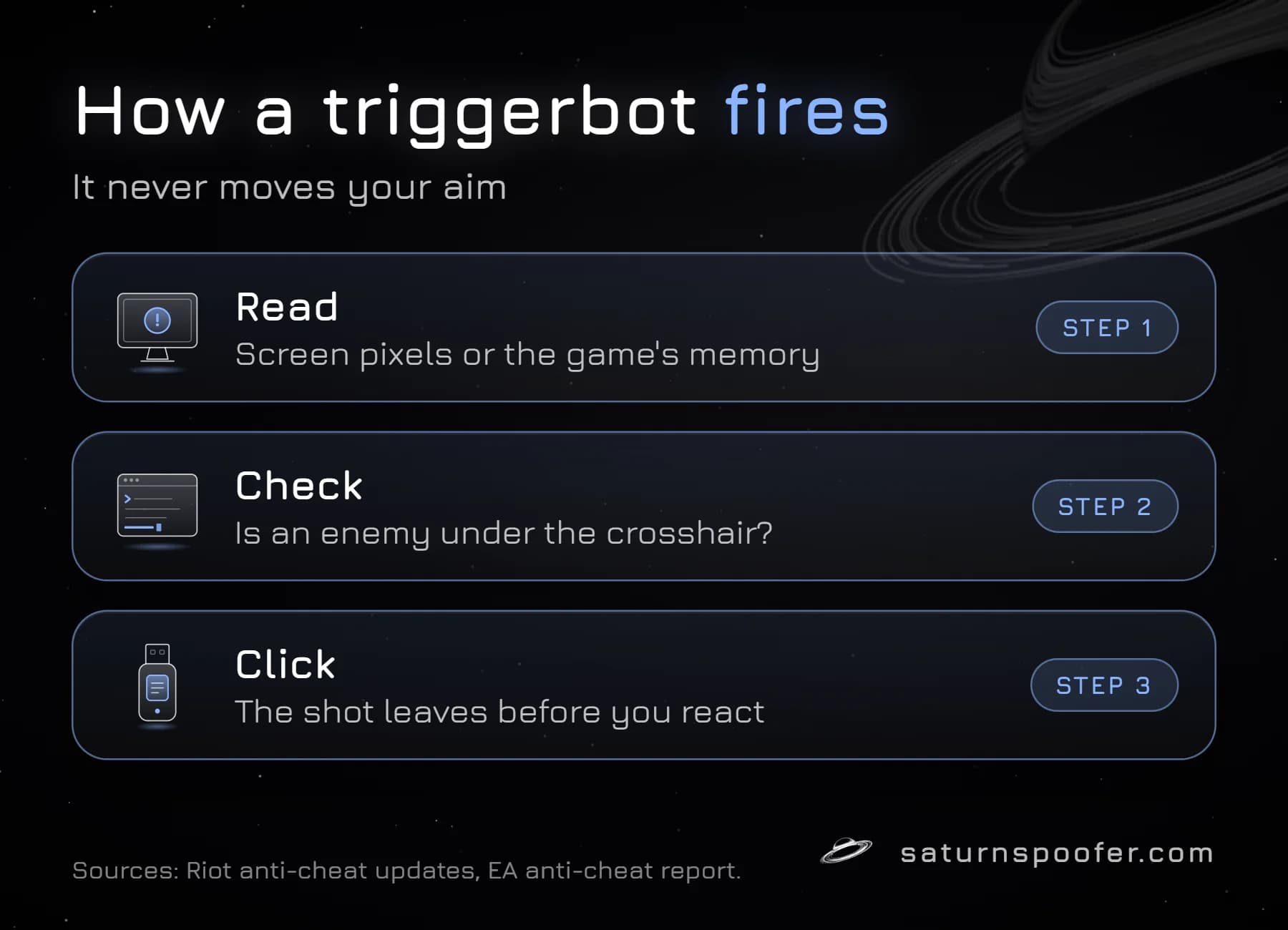
Read, check, click. Every triggerbot does those three things.
What Is the Difference Between an Aimbot and a Triggerbot?
An aimbot moves your aim onto the target, while a triggerbot leaves the aiming to you and only decides when you fire.
So the crosshair on a triggerbot clip moves like a human hand moved it, because one did.
That's the whole sales pitch: no snap for a spectator to see. An aimbot drags the crosshair onto a head, and a replay shows it.
I don't buy the idea that this makes a triggerbot the quiet option. Riot's February 2025 update says "something as simple as a triggerbot can still be a massive advantage" in a tactical shooter, and the advantage sits in the one thing a triggerbot changes: when the shot leaves.
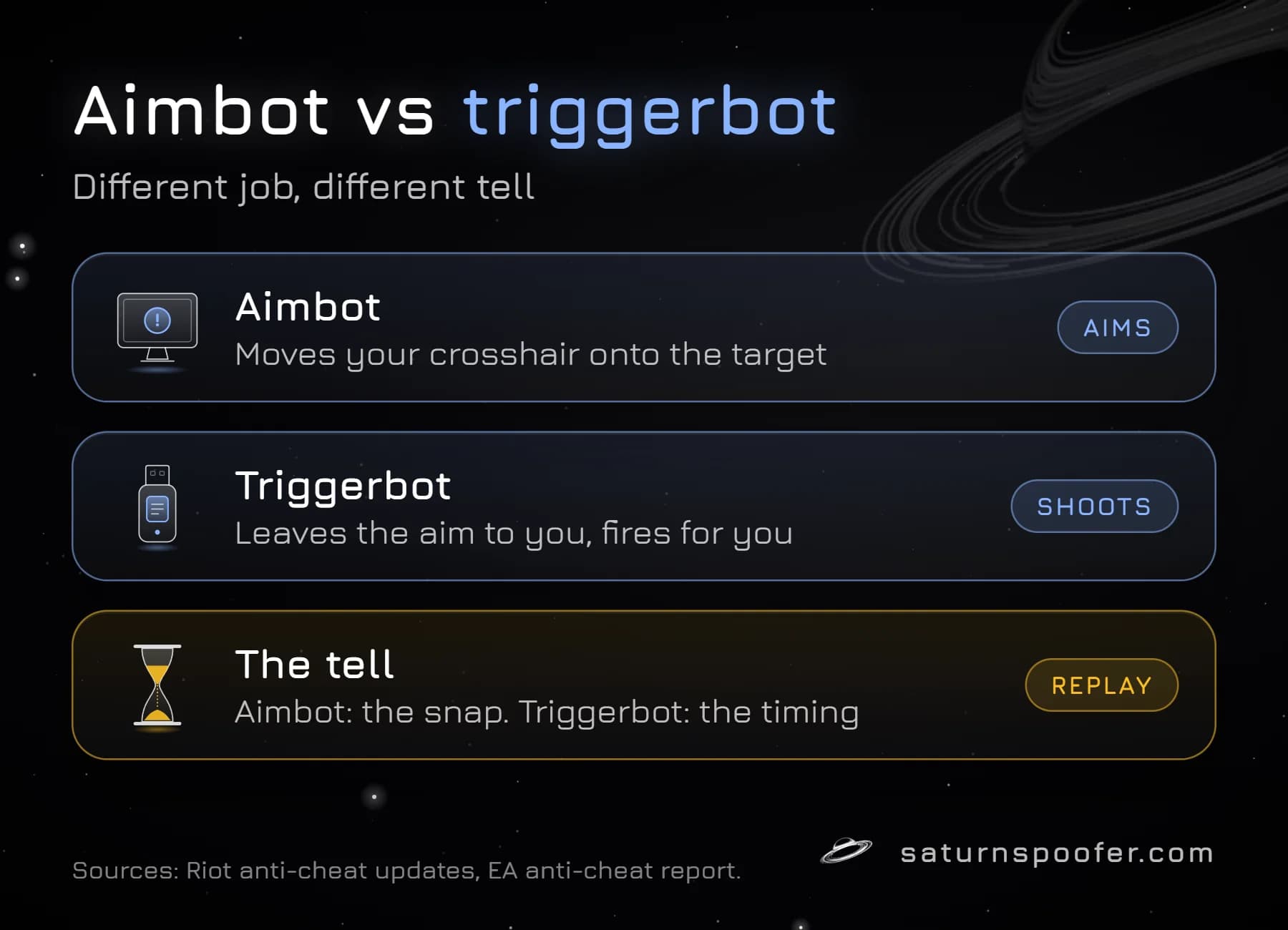
Many cheats bundle both, so the aimbot pulls the crosshair onto the head and the triggerbot fires the moment it gets there.
Aim is the aimbot's tell. Timing is the triggerbot's.
Can Anti-Cheats Detect a Triggerbot?
Yes. Anti-cheats look for a triggerbot in two places, on your PC and in the match data the server already keeps, and player reports add a third.
Riot's Valorant anti-cheat lead called this a "defense in depth" approach back in May 2020, with detection and bans as the last of three layers.
On the PC
On the PC, an anti-cheat looks for the triggerbot's code and for anything touching the game process or the input it receives.
That's the job of a kernel-level anti-cheat like Riot Vanguard or EA Javelin, which runs in the kernel, below the game itself, where it can see the drivers and injected code a memory-reading triggerbot depends on. For screen-reading triggerbots, Riot's rule on non-primary input means the click itself is a checkpoint.
In the Match Data
In the match data, behavioral detection looks for shots no human produces, such as fire that starts the instant a target appears, fight after fight.
Riot says its server-side "Behavioral" layer for Valorant works only from in-game performance data.
So it doesn't matter whether the triggerbot read the screen or the memory, because the moment each shot leaves lands in the same performance data the server already keeps for every player in the match.
A ban doesn't always arrive in the same match. The same February 2025 post says Riot keeps cheats detected by "obfuscating and delaying our response," so a cheater can play on for a while before the ban lands.
Riot also said in 2020 that it tracks player reports for cheating.
Reading the screen keeps a triggerbot out of the game's memory. It doesn't keep the shots out of the server's data.
Valorant Triggerbot
A Valorant triggerbot is a cheat that fires when an enemy crosses your crosshair, and the version Riot describes is a pixelbot, the screen-reading cheat it names as one of cheaters' three favorite methods of the past five years.
Riot's June 2026 update says pixelbots "can be extremely impactful in VALORANT due to the low time-to-kill."
When a fight ends in a few bullets, firing first decides a lot of it.
That's also why one question keeps coming back: can Vanguard see it? The theory is that a cheat reading the screen doesn't touch the game. Riot's own posts point the other way:
- February 2025: pixelbots are "as easy to detect as they are to install," and Riot says it puts most of them down quickly.
- June 2026: bans for local Python colorbots are left off Riot's ban chart because "there are too many of them."
- June 2026, in the same post: "Seriously, don't ask AI to make a VALORANT triggerbot. You will spend more tokens making it than Vanguard will spend banning you."
That last line comes from Phillip Koskinas, who works on anti-cheat at Riot. Of everything I read for this page, it's the line I'd put in front of anyone tempted to try.
Delay, hitchance and the rest of the menu are covered in how Valorant cheat settings work, which I won't repeat here.
Every one of those settings changes how human the shots look. None of them keeps the shots out of Riot's match data.
What Happens If You Get Caught Using a Triggerbot?
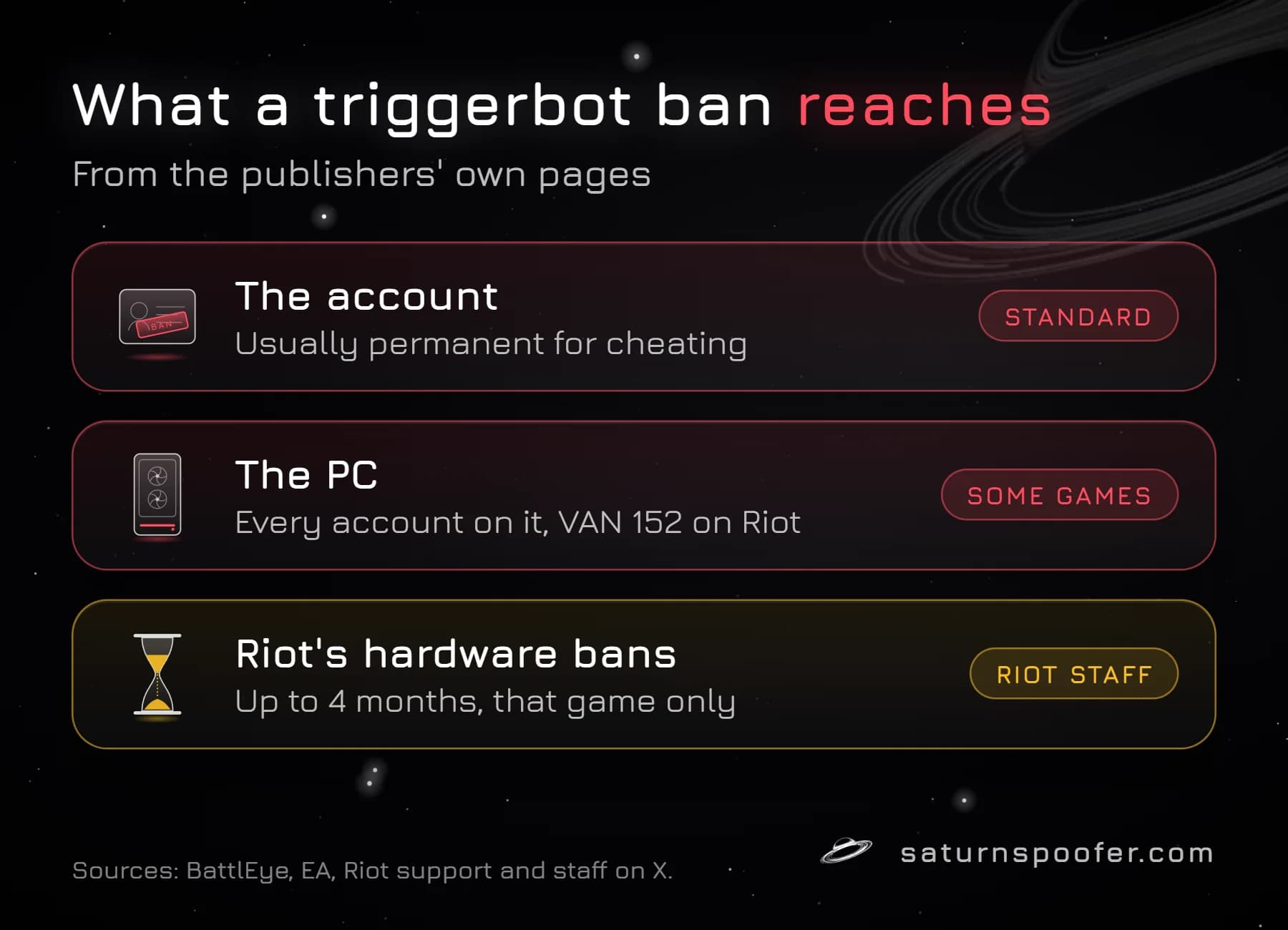
If you get caught using a triggerbot, you lose the account, and in some games the PC too.
Riot's terms of service list "using any unauthorized third party programs, including mods, hacks, cheats, scripts, bots" as a rule break, and a triggerbot is all of those at once.
The Account Ban
The account ban is the standard penalty for a triggerbot, and for cheating it's usually permanent.
BattlEye's support page says: "Global bans are permanent and no exceptions will be made."
EA says it has permanently banned thousands of cheater accounts across 14 EA games.
The Hardware Ban
A hardware ban for a triggerbot locks out the machine rather than the login, so any account you sign into on that PC gets caught along with the one that ran the cheat.
Riot's support article on HWID bans, updated May 31, 2026, lists being flagged for third-party tools (scripting or cheating) as a cause.
Login fails with error VAN 152, Riot bans any account the banned player uses, and a friend's account that logs in on that PC gets restricted too.
On October 2, 2026, Koskinas wrote that Riot's hardware bans last four months at most and apply only to the game the cheat was detected in. That's narrower than the support article's wording, which says "for the duration of the ban" across any Riot game.
When I checked both again on October 12, 2026, the gap was still there, so if a Riot game has banned your PC over a triggerbot, I'd ask Riot support how long is left before trusting either number.
Hardware ID ban rules differ by publisher, and not every publisher documents one.
A caught triggerbot costs the account every time, and in some games it costs the PC as well.
How Can You Tell If Someone Is Using a Triggerbot?
You can't prove a triggerbot from one clip, but a few timing patterns keep showing up when you spectate or watch a replay:
- The shot leaves the same instant the enemy appears in the crosshair, with no visible reaction gap.
- The gap between the enemy showing up and the shot is the same length every fight.
- The player fires mid-flick, exactly as the crosshair crosses a head.
- Shots fire at a sliver of an enemy that barely peeked, with the crosshair otherwise still.
What proves nothing: good crosshair placement, a pre-aimed angle, or one fast reaction.
A player holding a tight angle can look like one for a round, and good players have great nights.
So use the in-game report button and leave the call to the people who can see the match data.
Report it. Don't call it in chat.
The Risk Beyond the Ban
Free cheat downloads, triggerbots included, are one of the biggest malware lures aimed at gamers.
In a dataset of 53,896 devices hit by infostealer malware between June 7 and August 12, 2025, the threat exposure management firm Flare traced 41% of the infections back to a gaming-related file.
Gaming lures like cheats, mod menus, aimbots and skin changers accounted for over half of those, and a free triggerbot is exactly that kind of file.
I'd treat any free triggerbot as malware until something proves otherwise, because an infostealer on your PC does more damage than any ban.
Where an HWID Spoofer Fits (and Where It Doesn't)
An HWID spoofer is for one case only: a triggerbot ban, or any other cheat ban, has reached the PC itself, and you want that machine back in the game.
That's the job we built Saturn to do. We don't make cheats.
We change the hardware IDs your PC reports to an anti-cheat, such as the CPU, TPM, motherboard, disk, GPU, monitor and network adapter values, so a hardware-banned machine shows up as different hardware.
No triggerbot cover. No account unban. No protection for an account that keeps cheating, because the triggerbot gets caught the same way it did the first time.
Saturn is the wrong answer if:
- The ban stops at your account. That record lives on the publisher's servers, where no spoofer reaches.
- You expect it to keep a triggerbot account safe. It only keeps the PC from being locked out.
- You don't know yet whether the ban is on the account or the PC, or you still have an appeal open.
Where it does fit, Saturn is one loader, and your license decides which anti-cheats it covers: Riot Vanguard, Easy Anti-Cheat, BattlEye (with FiveM inside the BattlEye license), EA Javelin and Anti-Cheat Expert, across 61 games. The anti-cheats Saturn covers are listed with the license each one needs.
As of October 12, 2026, Saturn is currently undetected by every anti-cheat it supports, and the live status page is where that's tracked day to day. I'd keep one thing straight, though: that's Saturn's own footprint, not your triggerbot's, and an anti-cheat that catches the triggerbot still bans the account.
Temporary mode gives you unlimited profiles, and your original IDs come back when you close it. Permanent mode writes one profile for good.
Where it falls short: a spoofer breaks the same kind of rule a triggerbot does.
Riot's terms list circumventing any technological measure as a rule break, so Saturn changes what the PC reports, not what the rules say.
Every license comes with a 24-hour free trial, no card needed, only an email address for the key.
Triggerbot FAQ
What does a triggerbot do?
A triggerbot fires your weapon the moment your crosshair is on an enemy. You aim, and it clicks for you faster than a human can react.
Is a triggerbot the same as an aimbot?
No. An aimbot moves your crosshair onto the target, while a triggerbot only decides when to shoot. Many cheat menus include both, and publishers ban both.
Can a triggerbot be detected?
Yes. Anti-cheats look for the triggerbot's code and input on the PC, and server-side detection looks at shot timing in the match data. Riot wrote in February 2025 that pixelbots, the screen-reading cheats Riot ties to triggerbots, are as easy to detect as they are to install.
Can you get banned for using a triggerbot?
Yes. Every publisher I read for this page bans accounts for cheating software, and the ban is usually permanent. Some, like Riot, also ban the PC, so a triggerbot can lock out every account you play on from that machine.
Is aim assist a triggerbot?
No. Aim assist is built into a game by its developer, mostly for controller players, and it's allowed. A triggerbot is outside software that fires for you, and it breaks the publisher's rules.
Does an HWID spoofer hide a triggerbot?
No. An HWID spoofer only changes the hardware IDs a PC reports, and it does nothing to hide a triggerbot or any other cheat software. An account running a triggerbot gets caught the same way, spoofer or not.
Final Thoughts
A triggerbot is a cheat that only pulls the trigger, and that small job is enough for Riot to call it a massive advantage.
Whether it reads the screen or the memory, the shots land in data the server keeps.
My advice is short. If you're thinking about running one, the publishers' own pages say the account goes and sometimes the PC goes too. If you've been on the wrong end of one, hit report and get on with your next match.
Checked by Gabri on October 12, 2026. Sources: Riot's anti-cheat posts (May 2020, February 2025, June 24, 2026), Riot's HWID ban article (May 31, 2026) and terms of service, Phillip Koskinas on X (October 2, 2026), BattlEye support, EA's anti-cheat progress report, Flare (November 2025).