 Gabri
Gabri
Denuvo Anti-Cheat is a kernel-level anti-cheat made by Denuvo, the Austrian company Irdeto has owned since 2018, and it's a separate product from Denuvo's anti-piracy DRM. It watches how other software touches a game while you play, then hands what it finds to the game's studio, which decides who gets banned.
On October 12, 2026, eight games on Steam listed Denuvo as their anti-cheat, including ARC Raiders, THE FINALS and eFootball. Seven of them carry Steam's "kernel level" label.
I read Irdeto's own pages, the FAQ a studio published with answers from Denuvo's product manager, Embark's and Behaviour's Steam announcements, and every one of those eight store pages to put this together.
If a game has already banned your PC, not only your account, skip to the section on hardware bans. If you found Denuvo Anti-Cheat on your PC and want to know what it is, read straight through, because Saturn isn't your answer.
What Is Denuvo Anti-Cheat?
Denuvo Anti-Cheat is software that game studios license from Irdeto to catch cheats in online games, and it runs a driver in the Windows kernel while the game is open.
It comes from Denuvo Software Solutions GmbH, a company in Salzburg, Austria. Wikipedia's history of the company says Irdeto bought it, with its 45 employees, in January 2018, and that the anti-cheat was announced in March 2019.
Irdeto's 2020 explainer says Denuvo Anti-Cheat gives "real-time detection of aimbots, overlays and maphacks" that use drivers, hypervisors and other common cheat methods.
Today Irdeto sells it as a family of tools rather than one program. Its product page lists five:
- Kernel anti-cheat. The driver that watches game processes and blocks tools that try to change gameplay.
- Behavioral anti-cheat. Machine learning that looks for bots and non-human play.
- Anti-tamper. Protection against memory editing and reverse engineering of the game itself.
- Cheat intelligence. Reports on new cheats for the studio.
- Cheat market disruption. Test buys, investigations and payment disruption aimed at the people selling cheats.
When players say "Denuvo Anti-Cheat", they usually mean the first one, because that's the part that installs on your PC.
Denuvo Anti-Cheat vs Denuvo Anti-Tamper (the DRM)
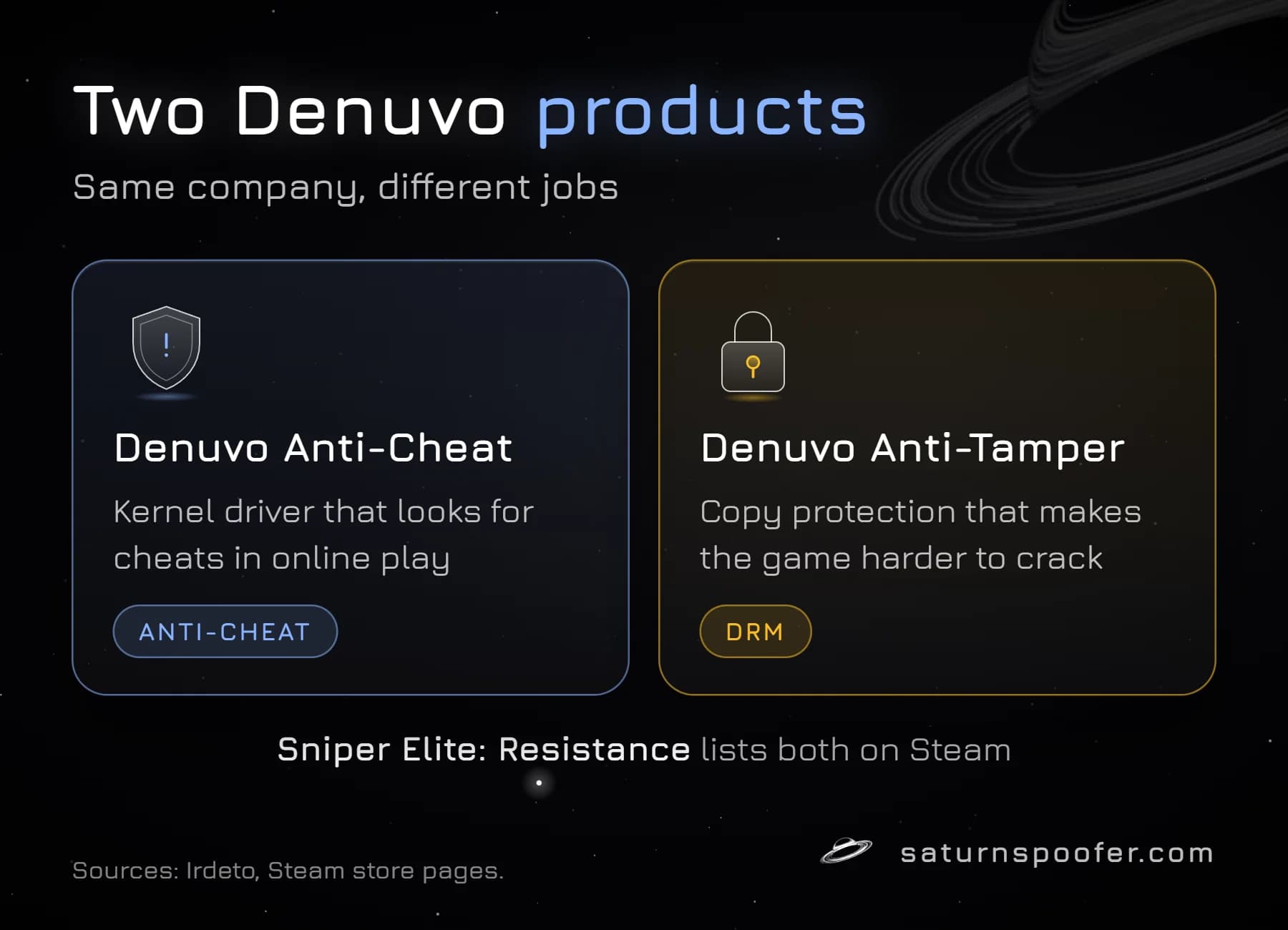
Denuvo Anti-Cheat and Denuvo Anti-Tamper are two different products from the same company, and a lot of what you'll read about "Denuvo" online is about the second one.
Anti-Tamper is copy protection. Irdeto's myth-busting post on Denuvo Anti-Cheat says it makes stores like Steam harder to crack, that it doesn't stop modding, and that it's "easy to cheat" in a game that only has Anti-Tamper. The same post says the two products "don't have much overlap."
The studios say it too. Behaviour's Steam post for its 2026 anti-cheat trial in Dead by Daylight drew the line as anti-cheat for catching cheaters, anti-piracy for stopping cracks, and said the trial included no DRM. The TRIBES 3: Rivals Denuvo Anti-Cheat FAQ says the game uses Denuvo's anti-cheat and "NOT" its DRM.
Sniper Elite: Resistance is the clearest example, because its Steam page lists both: "Denuvo Anti-tamper" under third-party DRM, and Denuvo again under kernel-level anti-cheat.
So when you see headlines in 2026 about Denuvo being cracked, Wikipedia describes them as cracks of the Denuvo protection on games like Doom: The Dark Ages, which is the copy protection, not the anti-cheat. They say nothing about how well the anti-cheat catches cheaters.
Two products, one name. I'd check which one a game runs before judging it, because the complaints you've read may belong to the other one.
Is Denuvo Anti-Cheat Kernel-Level?
Yes, Denuvo Anti-Cheat runs a kernel-mode driver, and seven of the eight Steam pages in the games list below label it "Uses Kernel Level Anti-Cheat".
That puts it in the same group as the other anti-cheats that run with Windows kernel access, such as Riot Vanguard, BattlEye and Easy Anti-Cheat. Irdeto's 2020 post gives the reason in one line: kernel access is needed to detect cheaters properly, and if it could work without the kernel, it would.
Denuvo's difference is timing. TRIBES 3's FAQ and Irdeto put three limits on when the driver runs:
- Not at Windows startup. TRIBES 3's FAQ says Denuvo's kernel driver "only runs while the game is running."
- Not always on game launch either. Denuvo's product manager told a TRIBES 3 player in March 2024 that the studio picks which game modes need the anti-cheat.
- Only in the modes that need it. Irdeto's 2020 post says it's active "only when your game is running competitive game modes."
Marauders is the odd one out on Steam: its page says "Uses Anti-Cheat Software" with Denuvo named, but without the kernel-level label the other seven carry.
What Denuvo Anti-Cheat Scans and Collects
Denuvo Anti-Cheat watches the game's own process and whatever software interacts with it, then sends that data to Denuvo's servers, where the detection happens.
Denuvo's product manager put it plainly in the March 2024 answers TRIBES 3 published: the anti-cheat monitors "specific parts" of memory related to the game process, doesn't read the contents of all your RAM, and doesn't look at a Word file, a browser tab or Discord unless that program interacts with the game.
He also said the detection itself runs on Denuvo's side: "Our solution does the cheat detection on the server side." Irdeto's myth-busting post adds that it collects how the operating system interacts with the game and sends it to Amazon-hosted servers.
The clearest data list I found is in the TRIBES 3 EULA excerpt on that FAQ, and I couldn't find anything as specific from Irdeto itself. It names what the studio shares with Denuvo:
- Your user ID, IP address, country, access dates and platform entitlement information.
- Information about the hardware and software you play on, and about your game sessions.
- Details of any unauthorized third-party program it detects, with the date and time.
- Statistics about the game process, the OS kernel and the applications that interact with the game.
The same excerpt says Denuvo "may create a hash" of technical data about your hardware, and that the data is processed on AWS servers in the EU.
The EULA says that hash exists to check that only paying players get in, and that it holds no personal data. Keep it in mind for the hardware ban section further down, because it shows a Denuvo game does read your hardware.
What Games Use Denuvo Anti-Cheat?
Eight games listed Denuvo Anti-Cheat on their Steam store pages when I checked them on October 12, 2026: ARC Raiders, THE FINALS, eFootball, Fishing Planet, Sniper Elite: Resistance, TRIBES 3: Rivals, VAIL and Marauders. Steam shows it in an anti-cheat notice on each game's page, which is the most checkable public source there is.
| Game | Studio | Steam's label |
|---|---|---|
| ARC Raiders | Embark Studios | Kernel level |
| THE FINALS | Embark Studios | Kernel level |
| eFootball | Konami | Kernel level |
| Fishing Planet | Fishing Planet LLC | Kernel level |
| Sniper Elite: Resistance | Rebellion | Kernel level, plus DRM |
| TRIBES 3: Rivals | Prophecy Games | Kernel level |
| VAIL | AEXLAB | Kernel level |
| Marauders | Small Impact Games | Anti-cheat, no kernel label |
Four of those pages, ARC Raiders, THE FINALS, eFootball and Fishing Planet, add a warning that Denuvo "Requires manual removal after game uninstall."
Embark's two games are the biggest names here. THE FINALS' patch notes say the Denuvo rollout started in October 2025 and was complete by November 13, 2025, and ARC Raiders' Store Update 1.35.0 on June 30, 2026 said the rollout "to all players" was done. Eight weeks earlier, Embark's May 7, 2026 "Ensuring Fair Play" post still named Easy Anti-Cheat as the kernel-level layer behind ARC Raiders' anti-cheat and ban rules.
Games that ran it and stopped
Three more games show up on the Denuvo Anti-Cheat lists I read, but none of them runs it today:
- Doom Eternal. Wikipedia says it was the first game to use Denuvo Anti-Cheat, in May 2020, and that id Software reverted it within a week after player backlash.
- Dead by Daylight. Behaviour ran a Steam-only trial from September 2 to September 15, 2026, then removed Denuvo. Its Steam page now lists Easy Anti-Cheat.
- Zero Hour. GamingOnLinux lists it under Denuvo Anti-Cheat, but its Steam page showed no anti-cheat notice when I checked. Treat it as UNVERIFIED.
Why there's no official games list
Denuvo doesn't publish a client list. When a TRIBES 3 player asked for one, Denuvo's product manager said NDAs stop it from naming clients, and that Marauders was the only one it could share, because Small Impact Games did a public case study.
So any list, this one included, is built from what studios disclose. I used Steam's notice because you can check it yourself, and I'd trust it over a list that doesn't say where its names came from.
Who Bans You: Denuvo or the Game Studio?
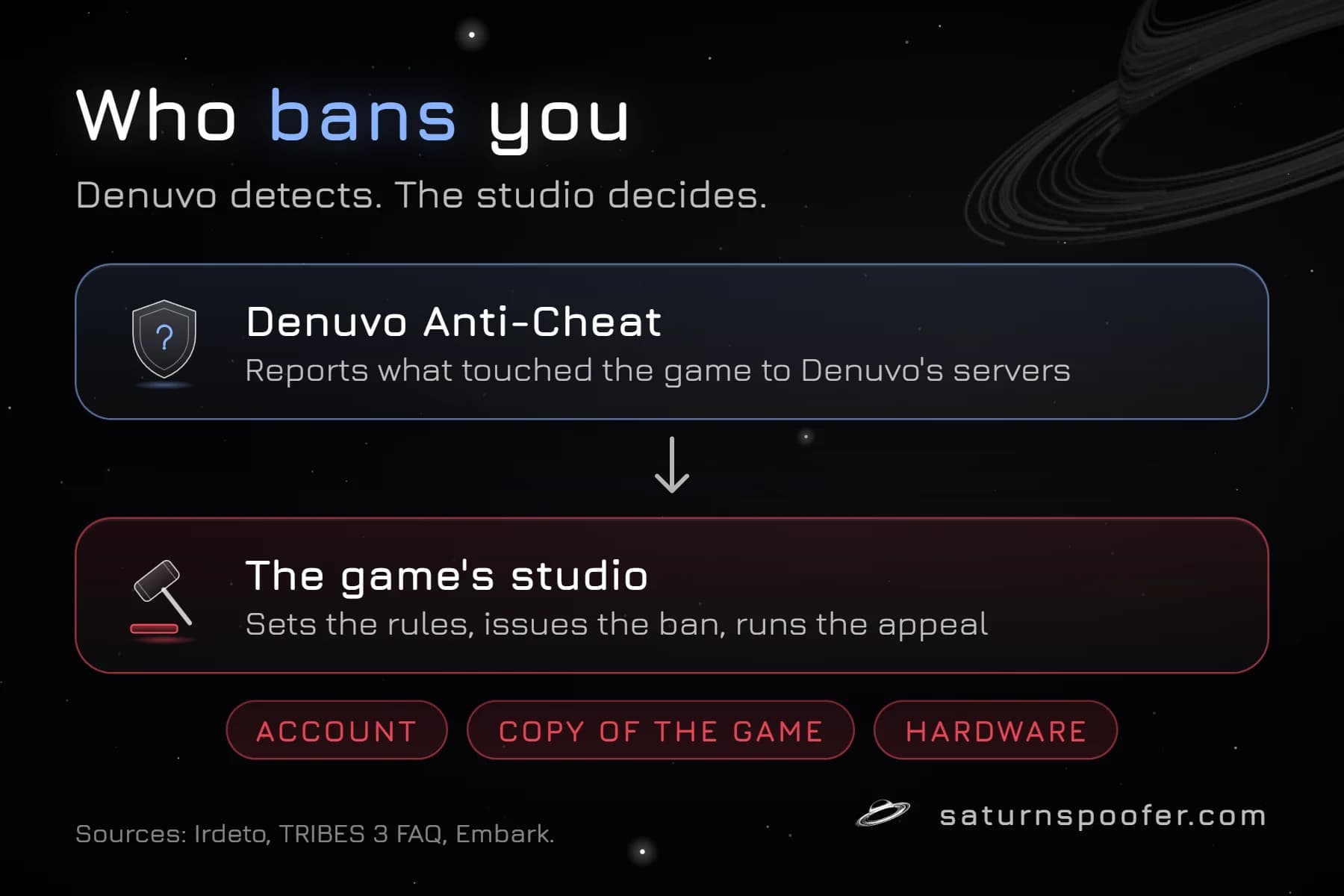
The game studio bans you, not Denuvo. Denuvo Anti-Cheat detects, and the studio decides what happens next.
Irdeto wrote in 2020 that the anti-cheat "only detects cheats" and that game publishers "then decide how to respond to the offenders." Denuvo's product manager said the same thing in 2024: what counts as cheating is "a server side policy decision" that belongs to the game developer.
That's why bans look so different from one Denuvo game to the next. Two studios have published what they do with its detections:
- TRIBES 3: Rivals. Its FAQ says Denuvo's detail gives the studio the confidence to issue VAC bans or hardware bans.
- ARC Raiders. Embark's "An Update on Anti-Cheat", posted on Steam on September 30, 2026, says any account caught using cheats is permanently banned. It adds license restrictions that stop a sanctioned copy of the game working on another account, bans for accounts linked to a banned copy, and hardware bans when "a single machine is being used for cheating."
Embark also says it pairs Denuvo with Anybrain detections and its own machine learning models, and that a human stays in the loop through appeals.
If you think a ban is wrong, appeal to the studio that issued it. Denuvo doesn't run the appeal.
Detection is Denuvo's. The ban is the studio's. The appeal is the studio's too.
Is Denuvo Anti-Cheat Safe?
Denuvo Anti-Cheat carries the same risk as any kernel driver: code at that level isn't isolated, so a bug can crash Windows. Irdeto's case is that the driver has been audited and does less than people fear.
Irdeto's 2020 post makes four specific claims. The driver went through whitebox and blackbox audits and was penetration-tested by independent cheat developers. It doesn't stream code from the web, so a compromised server can't push arbitrary code to your PC. It asks for permission before it installs. And it can be uninstalled in one click.
The same post admits kernel drivers come with risks "like blue screens", and that it would avoid the kernel if it could.
On performance, TRIBES 3's developers say they tested the game with and without Denuvo Anti-Cheat and saw no noticeable difference. Dead by Daylight's run was a limited-time trial from the start. Behaviour ended it after 13 days and said it would review the data and feedback before any future trial, without saying how Denuvo performed.
You can't audit the driver yourself. What you can check is whether a game runs it, which modes need it, and what the studio's EULA says it shares.
Hardware Bans in Denuvo Games, and Where an HWID Spoofer Fits
A hardware ban in a Denuvo game is the studio's decision, applied to your PC instead of your account, and it's the only situation on this page where an HWID spoofer matters.
Embark is the clearest example. Its September 30 post says that when it has enough evidence a machine is used for cheating, "we can prevent the game from running on that system", and that it lowered the threshold for those bans. That's a ban on the PC, which is how bans that land on a PC's hardware IDs work in other online games. I couldn't find a page from Embark or Denuvo that says which hardware identifiers those bans are tied to.
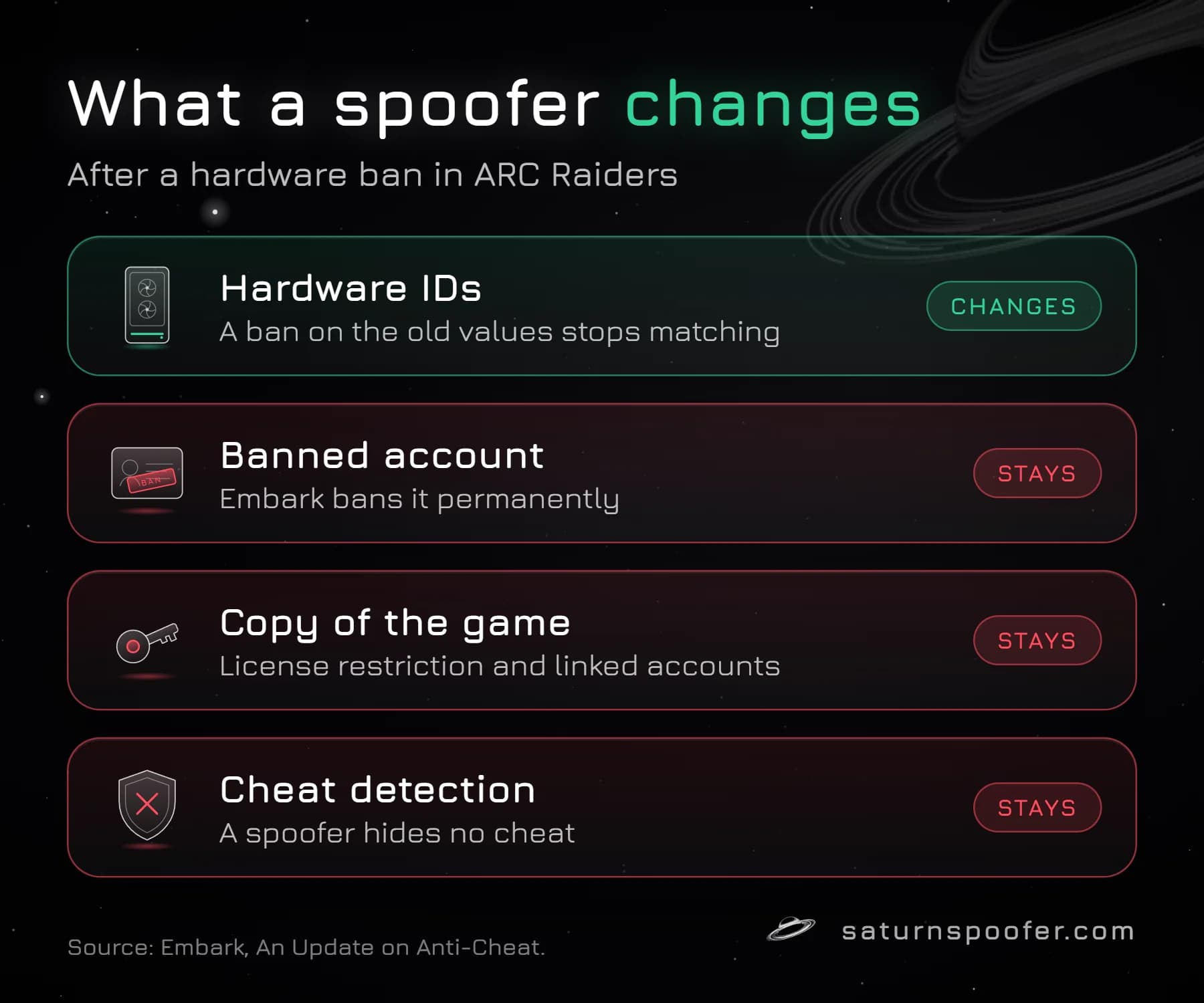
Start with what a spoofer can't touch, because in Denuvo games that's most of it:
- A banned account. Embark bans the account of anyone caught cheating, and that account stays banned.
- A license restriction. Embark ties some sanctions to the copy of the game, which no change to your PC undoes.
- Linked accounts. Embark bans accounts linked to a banned copy, whatever PC they play on.
- The detection itself. Denuvo Anti-Cheat looks at what touches the game. A spoofer doesn't hide a cheat from it.
That's where Saturn fits, and where it stops. Saturn is an HWID spoofer, not a cheat. It changes the hardware identifiers Windows reports, from disk and motherboard serials to the TPM, MAC address and monitor EDID, so a ban saved against your old values stops matching that PC. The mechanics of the hardware serials an HWID spoofer changes are the same in every game.
Saturn has no Denuvo product. Saturn covers ARC Raiders with its EAC license, from the same single loader as its other licenses. If Embark banned your PC rather than only your account, Saturn's ARC Raiders HWID spoofer is built for that case, and the 24-hour trial needs an email address but no card.
For any other game on the list above, check Saturn's game pages before you assume it's covered. Most of them aren't.
Embark itself says hardware bans are "not a silver bullet" and that it's working to put them on more systems. If you're reading about ARC Raiders cheats, that's the part to keep in mind: the account goes first, and a spoofer never brings it back.
Denuvo Anti-Cheat FAQ
Who makes Denuvo Anti-Cheat?
Denuvo Software Solutions GmbH, based in Salzburg, Austria, makes it. Irdeto, a digital security company, bought Denuvo in January 2018 and sells the anti-cheat as "Denuvo by Irdeto".
Is Denuvo Anti-Cheat the same as Denuvo DRM?
No. Denuvo Anti-Tamper is copy protection against cracks, and Denuvo Anti-Cheat detects cheats in online play. Irdeto says the two products don't have much overlap, and a game can run either one or both.
Does Denuvo Anti-Cheat run all the time?
No. TRIBES 3's FAQ says the kernel driver only runs while the game is running, and Denuvo's product manager says studios choose which game modes need it at all.
Does Denuvo Anti-Cheat work on Steam Deck?
It can, through Proton. TRIBES 3 says Denuvo Anti-Cheat is compatible with Proton and Steam Deck but not native Linux, and GamingOnLinux reported in September 2026 that THE FINALS and ARC Raiders needed Proton Experimental.
Can Denuvo Anti-Cheat ban your hardware?
Denuvo detects, and the studio decides the ban. Some studios do ban hardware: TRIBES 3 says it can issue hardware bans, and Embark says ARC Raiders blocks machines caught running cheats.
How do you remove Denuvo Anti-Cheat?
Uninstalling the game isn't always enough. Steam's pages for ARC Raiders, THE FINALS, eFootball and Fishing Planet say Denuvo "Requires manual removal after game uninstall", and Irdeto says it can be uninstalled in one click.
Final Thoughts
Denuvo Anti-Cheat is Irdeto's kernel-level anti-cheat, not its DRM, and on October 12, 2026 eight Steam games named it, led by Embark's ARC Raiders and THE FINALS.
It watches what touches the game and reports to Denuvo's servers. The studio running the game decides who gets banned, how, and whether the ban reaches your PC.
If you want to know whether a game runs it, read the anti-cheat notice on its Steam page. If you were banned, the studio is who you talk to first.
Checked by Gabri on October 12, 2026. Sources: Irdeto's Denuvo Anti-Cheat product page and its July 23, 2020 post "Keeping the fight fair"; the TRIBES 3: Rivals Denuvo Anti-Cheat FAQ, including Denuvo's March 4, 2024 answers; the Steam store pages of the eight games in the table, Dead by Daylight and Zero Hour; Embark's Steam posts for THE FINALS (October 23 and November 13, 2025) and ARC Raiders (May 7, June 30 and September 30, 2026); Behaviour's Dead by Daylight Steam posts (August 26, September 2 and September 15, 2026); Wikipedia's Denuvo article; GamingOnLinux's Denuvo Anti-Cheat list. UNVERIFIED: Zero Hour's current anti-cheat. Dead by Daylight's support FAQ could not be read and was not used.