 Gabri
Gabri
An HWID spoofer is software that changes the hardware identifiers your PC reports, so a machine carrying a hardware ban shows up to an anti-cheat as different hardware.
It doesn't touch your account, your game files or anything a publisher keeps on its own servers, and that one distinction decides whether a spoofer is any use to you.
As of October 2026, the five anti-cheat systems most likely to be behind a hardware-level block on a Windows PC are Riot Vanguard, Easy Anti-Cheat, BattlEye, EA Javelin Anticheat and Anti-Cheat Expert. Each one reads your system differently, and none of them publishes the exact set of IDs behind a ban.
For this guide I read the anti-cheat documentation, Riot's support pages, Microsoft's own docs and the forum threads where people describe what went wrong after running a spoofer.
WHERE I STAND I'm Gabri, and I work on Saturn. Saturn is an HWID spoofer, and it comes up later on this page, so you should know that before you take anything here at face value. Here's how I kept it from bending the facts:
- Every ban rule comes from the publisher's own page or its own staff, with the date I read it.
- If you don't need a spoofer, I say so first, before Saturn comes up at all.
- The risks section covers every spoofer on the market, ours included.
That's a lot of disclosure for a blog post, but you're about to make a call about your PC, and you should know who's talking.
What Is a Spoofer in Gaming?
A spoofer in gaming is a tool that makes your PC, your location or your connection look like something it isn't to the software checking it.
The word also covers caller ID tricks and fake email senders, and on phones it means GPS spoofing in games like Pokémon Go. On PC, though, "spoofer" almost always means an HWID spoofer, the tool players reach for after a hardware ban keeps a machine locked out no matter which account logs in.
Three other tools get confused with it often, and I think it's worth separating them before going any further:
- A VPN changes the IP address your connection shows, and it does nothing to the IDs your hardware reports.
- A MAC address changer changes one network value, and since a hardware ban is built from many values, that one change rarely matters on its own.
- A cheat changes what happens inside the game, which a spoofer never does, and a spoofer won't hide one from an anti-cheat either.
On a gaming forum, read "spoofer" as "HWID spoofer".
What Does an HWID Spoofer Change?
An HWID spoofer changes the serial numbers and IDs your PC's components report to any program that asks for them, from the disk and motherboard to the network card and monitor.
There's no single "hardware ID" stored in one place. What people call an HWID is a fingerprint built from values pulled out of several parts at once, and these are the ones that usually make it up:
| Identifier | Where it lives | Usually spoofable? |
|---|---|---|
| Disk serial number | HDD, SSD or NVMe firmware | Yes |
| Motherboard serial and system UUID | SMBIOS tables | Yes |
| MAC address | Network adapter | Yes |
| CPU ID | Processor | Partly. Some fields are fixed |
| TPM identifiers | Trusted Platform Module | Yes |
| GPU identifier | Graphics card | Yes |
| RAM serial | SPD data on each module | Yes |
| Monitor EDID | Display firmware | Yes |
| USB device serials | Connected devices | Yes |
| UEFI variables | Motherboard firmware | Yes |
| Volume serial and MachineGuid | Set by Windows itself | Yes |
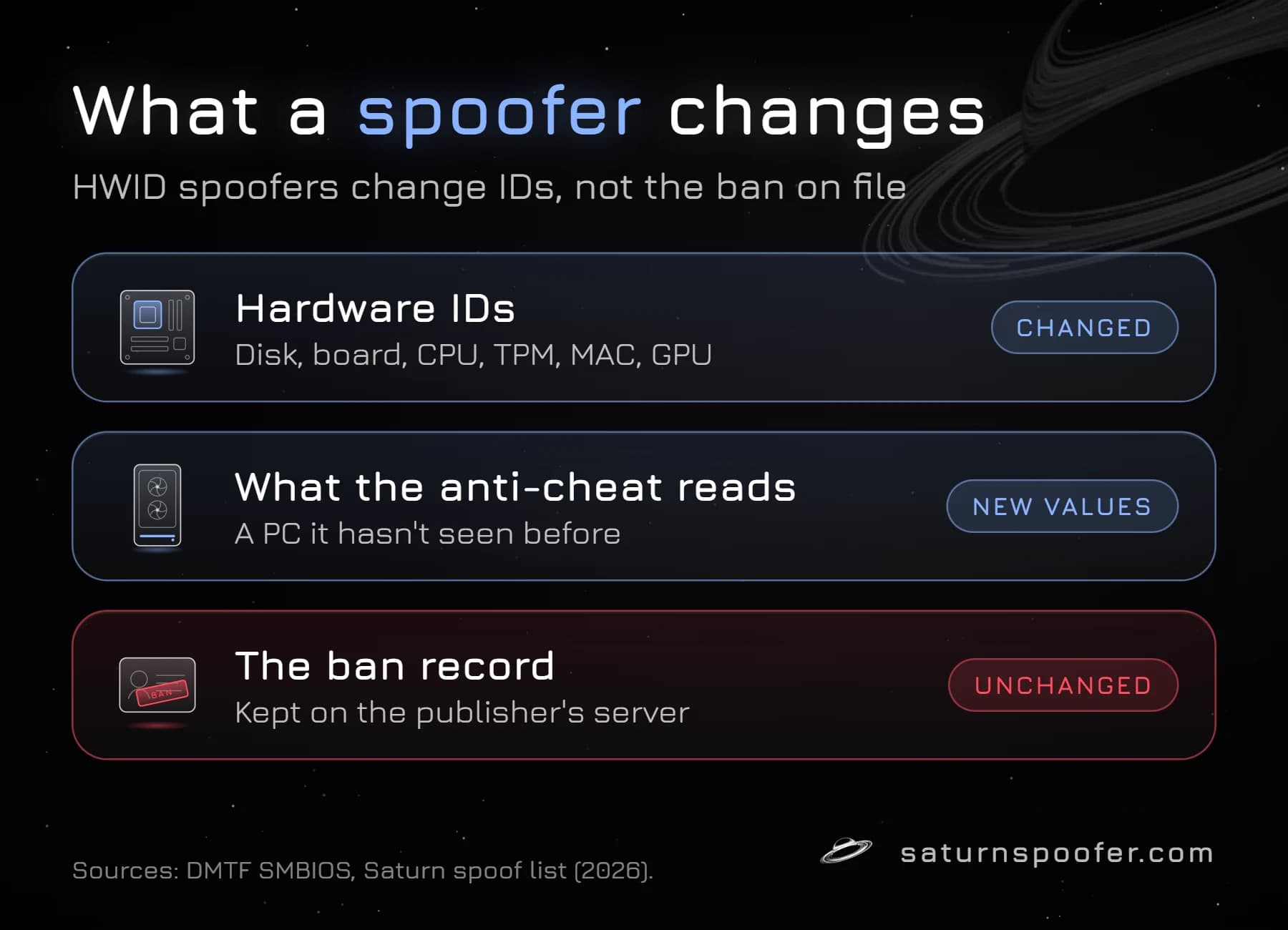
SMBIOS is a published DMTF standard, so motherboard values are easy to collect: any program can read them through a documented interface, and they don't change when you reinstall Windows.
Because the fingerprint is a composite, the number of values a tool covers matters far more than any single one of them.
Change a MAC address and leave the motherboard UUID alone, and you've got a machine that still matches on most of its fingerprint. That's the flaw in the manual fixes people try first: they change one value out of ten and expect the ban to forget them.
It's also why a hardware ID ban survives the obvious fixes. Reinstalling the game does nothing. Formatting a drive gives you a new volume serial, because Microsoft's developer docs say Windows assigns that number when a disk is formatted. The serial the manufacturer set is a separate value, and it stays exactly the same.
A clean Windows install rebuilds the registry and leaves the motherboard, CPU and network card reporting precisely what they reported the day the ban landed.
When you compare tools, count the values each one covers before you look at anything else.
How Does HWID Spoofing Work?
HWID spoofing works by catching the requests software makes for hardware IDs and answering them with substituted values instead of the real ones.
A temporary spoofer never touches the component, so only the answer changes, while a permanent spoofer also rewrites the stored values, so its change survives a restart.
Where that interception happens is the main technical difference between one spoofer and another. In my reading it decides more about a tool than anything on its download page, because it sets how much of the fingerprint the tool can reach.
User-Mode Spoofing
User-mode spoofing runs with the same privileges as an ordinary app, so it can edit registry values, change a MAC address through the network stack and alter what Windows reports through standard interfaces like WMI.
It's simple to build and needs no driver, but it's weak against anything that reads hardware directly. A program with deeper access can skip the layer a user-mode tool works on and ask the device itself.
That's where most free and script-based tools sit. They fool software that trusts the registry, and nothing else.
Kernel-Mode Spoofing
Kernel-mode spoofing runs as a driver at ring 0, the same privilege level as Windows itself and the level kernel-level anti-cheats work at.
Riot Vanguard is the clearest example, because by default its driver loads when Windows starts rather than when the game launches. Since June 2026, Riot has let PCs that pass its Pre-Check run Vanguard on demand instead.
From ring 0, a spoofer can also answer the low-level requests, including the calls that query storage devices directly and the interfaces that expose SMBIOS tables.
Consistency is the part that's easiest to underestimate. If a disk reports one serial through one interface and a different serial through another, the mismatch is a signal on its own. The same goes for values that drift between one query and the next.
A spoofer that changes some values and misses others can leave a PC looking stranger than it did before anyone touched it.
DMA and Open-Source Spoofers
A DMA spoofer changes hardware IDs through direct memory access, the same route DMA cheats use to read a game, by rewriting the values held in the PC's live memory.
You can read one of them line by line. A GitHub project that calls itself "the first open-source DMA-based HWID spoofer implementation" is written in Rust and covers SMBIOS, disk, network, GPU, monitor, TPM, EFI and USB values.
Its own README, which I read on October 12, 2026, warns that it "modifies live kernel state" and tells you to use a VM first. Open source lets you read the code before you run it, which no free closed tool allows. The awkward part: anti-cheat teams can read it too, and the author calls it research code.
Spoofer, Changer or Cleaner?
An HWID spoofer, an HWID changer and an HWID cleaner get sold as if they were the same thing, but only two of them are.
| Tool | What it does | Clears a hardware ban? |
|---|---|---|
| HWID spoofer | Changes the IDs your hardware reports | Yes, on that PC |
| HWID changer | Another name for a spoofer | Yes, on that PC |
| HWID cleaner | Deletes leftover files and registry entries a game wrote | No |
A cleaner is housekeeping: it removes traces that tie your PC to past activity and changes nothing about the IDs a ban is built on.
A tool that only cleans isn't a spoofer, whatever its download page calls it, and I wouldn't pay for one expecting it to clear a ban.
Temporary and Permanent Spoofing
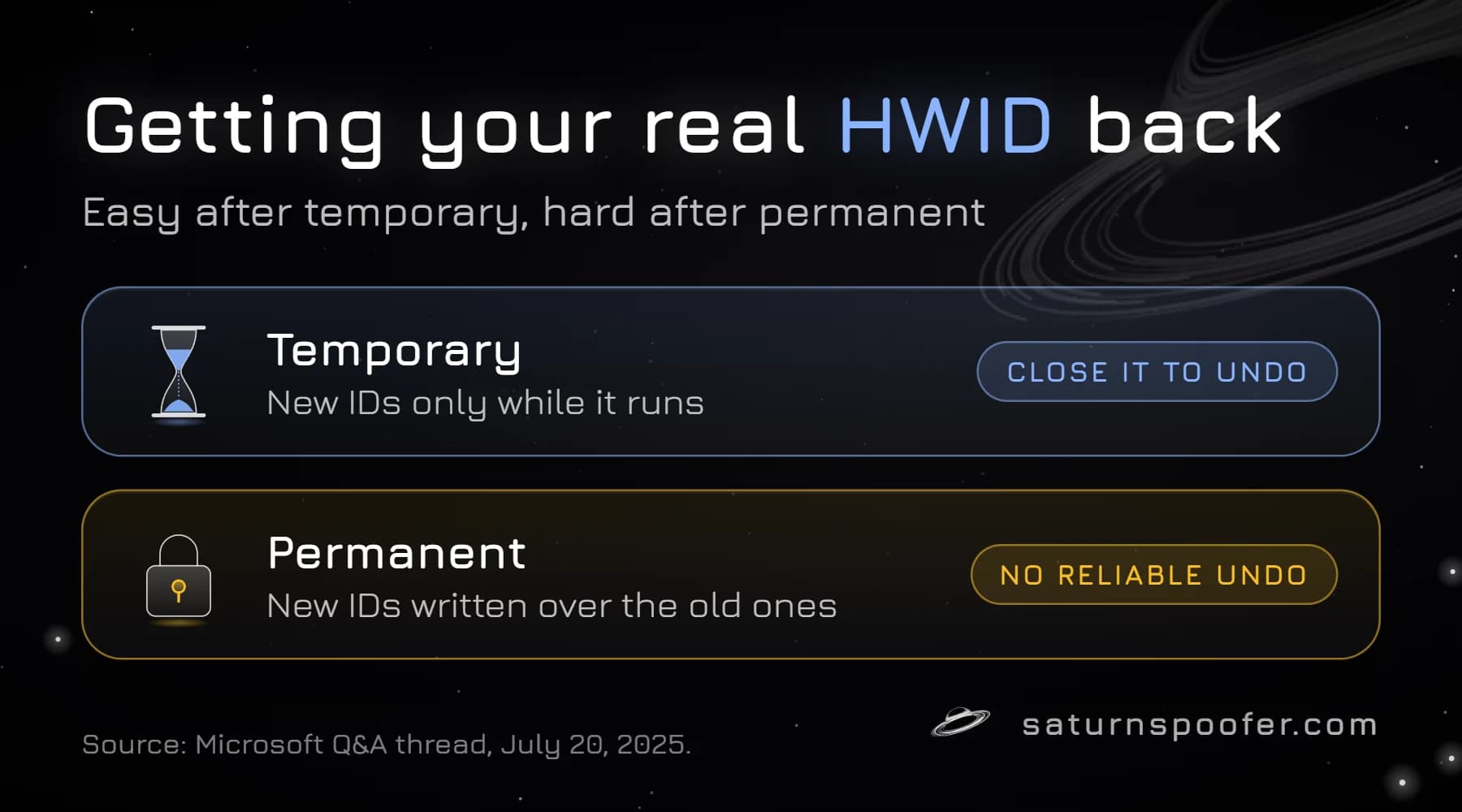
HWID spoofers come in two kinds: a temporary spoofer swaps the IDs only while it's running and hands back your real IDs when you close it, while a permanent spoofer writes new values that stay after a restart.
Neither one wins outright. A temporary spoofer leaves nothing behind, which matters if the PC is shared, sold or used for work. A permanent one saves you running anything before you play, at the cost of living with a changed fingerprint for good.
Some tools call a saved set of spoofed IDs a seed, others a profile, and the idea is the same: one seed or profile is one fake identity for your PC.
One thing gets mixed up constantly, because a lifetime license and a permanent profile aren't the same thing at all.
The license is about access and payment, while the split between permanent and temporary HWID spoofers is about whether the spoofed IDs survive a restart.
If you're not sure which to pick, I'd start temporary, since you can always go permanent later and going back is the hard direction, as the next section shows.
Can You Get Your Original HWID Back?
You can get your original HWID back easily after a temporary spoofer, because closing it makes your PC report its real IDs again.
After a permanent spoofer it's much harder, since the original values were overwritten and there's no reliable "unspoof" button you can press afterwards.
I read a Microsoft Q&A thread from July 20, 2025 that shows how this goes. A user who had run a permanent spoofer on a laptop the year before asked how to get the old IDs back, and the volunteer advisor who answered said no tool reliably undoes it.
The advisor pointed to a clean Windows install plus a BIOS reset, or a BIOS reflash from the laptop maker if the firmware values had been changed. Even then, the advisor only said that can help, mostly when the spoofer changed software-level values.
Two habits save you this trouble, and I'd treat both as non-negotiable before a permanent spoof:
- Note your real IDs before you spoof anything. The guide to checking and changing your HWID shows where each value lives on Windows.
- Run temporary first. If it does the job, you never needed the permanent change in the first place.
Temporary is reversible. Permanent isn't, so pick knowing that.
Can an HWID Spoofer Damage Your PC?
An HWID spoofer can cause real problems on a PC, and the damage people report is to Windows activation, streaming apps and system stability rather than to the parts themselves.
The volunteer advisor in the July 20, 2025 Microsoft Q&A thread warned against downloading unknown "HWID reset tools", because "many are unsafe and could further damage your system."
Windows activation. Microsoft says that when you install Windows 11, "the digital license associates itself with your device's hardware", and its reactivation guide warns that after a big enough hardware change, "Windows will no longer find a license that matches your device."
A spoofer that changes motherboard IDs can look like exactly that kind of change. Microsoft's advice is to link your Microsoft account to your digital license, which is what lets you reactivate after a hardware change.
Streaming and video playback. In an August 26, 2023 Microsoft Q&A thread, a user wrote that after running a spoofer, Windows lost its activation, Netflix and Disney+ stopped playing, and game cutscenes wouldn't load.
The answer they got was to back up their files and reinstall Windows from scratch. That's one user's report rather than a rule, but it's the failure people ask about most.
Crashes and boot problems. A badly written kernel driver can crash Windows, because code running at ring 0 has no safety net, and that's true of any driver, spoofer or not.
Malware. This is the big one. A spoofer needs deep access to your system to work at all, which makes a free spoofer from an unknown source the perfect way to deliver something else. Run one from a forum or a Discord server and you've handed ring 0 to someone you can't check.
The reports are about software, not broken parts: your Windows install, your accounts and your license are what's at risk.
What an HWID Spoofer Does Not Change
An HWID spoofer changes what your hardware reports and nothing else, and most of the disappointment I read about comes from people expecting more.
It doesn't unban your account. Account bans live on the publisher's servers, attached to your login, so changing your PC's IDs has no effect on a record Riot or Epic holds about an account.
A banned account stays banned on a spoofed PC, on a new PC and on someone else's PC. The route for that is a support ticket, such as a Valorant ban appeal.
It doesn't hide your IP address. A network block follows your connection rather than your hardware, so a spoofer and a VPN solve two different problems.
It doesn't remove behavior flags. When a system judges how an account plays, your disk serial isn't part of the input, and if you think a flag was a mistake, like a Valorant false ban for boosting, that's a separate process.
It doesn't make cheating safe. A spoofer changes IDs and does nothing about what an anti-cheat finds running in memory, so a PC that looks new while running a detected cheat gets flagged anyway.
It doesn't change your physical hardware. No part is altered or replaced, and even a permanent spoofer that rewrites stored values leaves the parts as the parts.
No account unban. No IP change. No cheat cover.
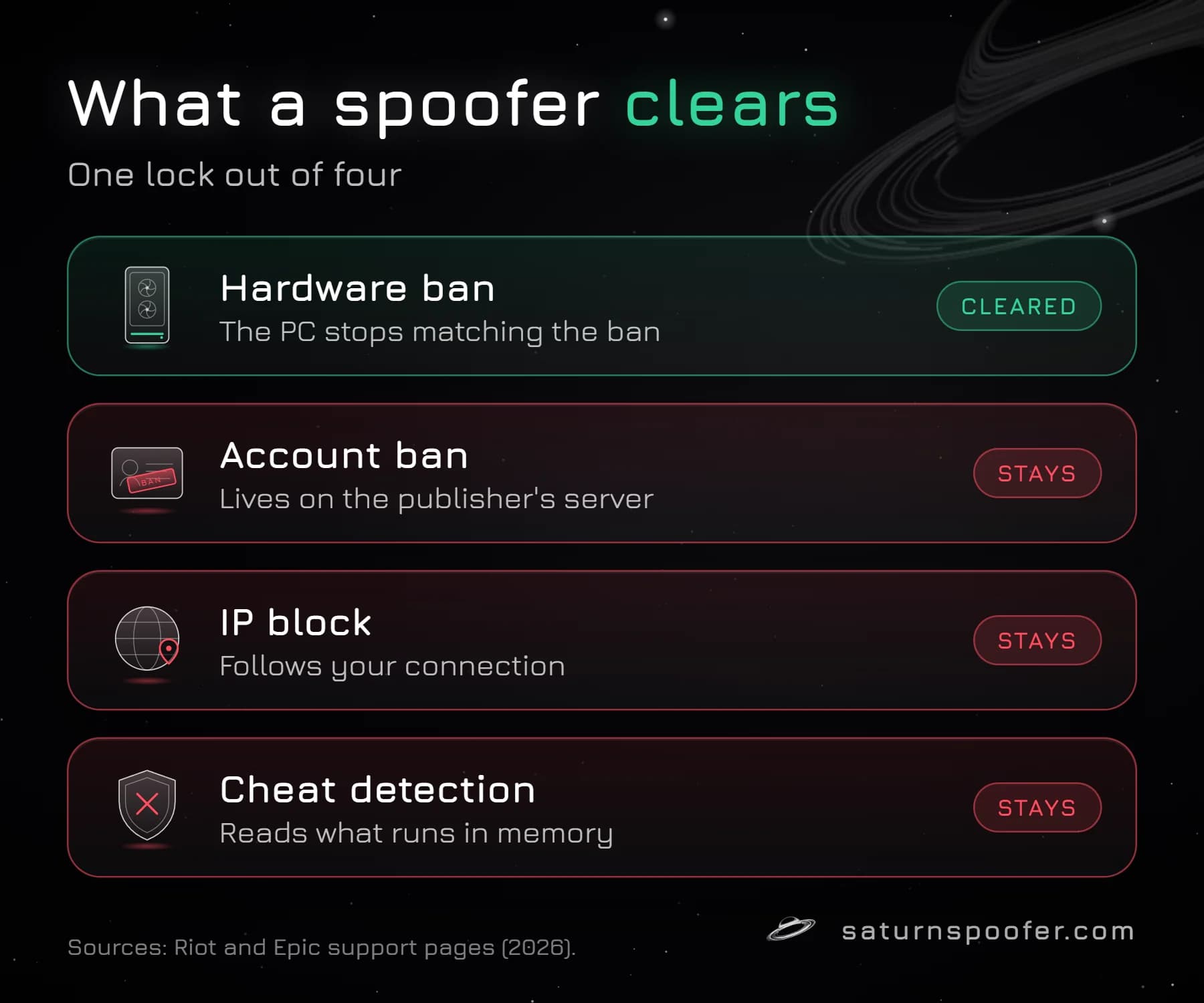
I think of a hardware ban as one lock among several. A spoofer opens that one lock, and if your account is banned too, the door stays shut.
On Riot games, the code at login usually tells you which lock you're facing, because error VAN 152 means the PC is banned, not the account.
Compatibility, Limitations and Risks
Every HWID spoofer comes with risks, and you should know them before you pick a tool, ours included.
The terms of service. Getting around a ban breaks the terms of nearly every game that issues one, and the realistic cost is losing accounts rather than ending up in court.
What publishers do take to court is cheat selling, as when Riot was awarded $10 million in 2017 in its lawsuit against the makers of LeagueSharp, a League of Legends cheat. Using a spoofer sits in a different category, but "not prosecuted" isn't "allowed", and anyone telling you otherwise is selling something.
Publishers look for spoofers. Epic's Hardware Identifiers Warning help page, which I read on September 29, 2026, says Epic detects tools that hide or change a PC's hardware IDs, and that a player using one may be removed from matches or see the Fortnite account banned for good.
Other publishers say less in public, but I haven't found one that welcomes it.
Detection moves. Anti-cheats update, and when a method gets picked up, the players using that tool get hit together, which is how ban waves work.
A spoofer is maintained against a moving target, and that maintenance is what you're paying for. So I'd trust a dated claim over a permanent one: as of October 12, 2026, Saturn is currently undetected by every anti-cheat it supports, and the live status page is where that's tracked day to day.
One spoofer doesn't fit every anti-cheat. Each system reads your PC its own way, so I'd check the one your game uses before anything else:
- Easy Anti-Cheat loads with the game and protects titles like Fortnite and Rust.
- BattlEye's privacy policy says it may keep hardware serial information after a detection.
- EA Javelin Anticheat covers EA's own titles, including Battlefield 6 and Apex Legends.
- Anti-Cheat Expert is Tencent's system, used by games like Delta Force.
- Riot Vanguard protects Valorant and League of Legends, and by default it starts with Windows, before the game is even open.
A tool built for one of these isn't automatically any good against another, so check which anti-cheat protects your game before you assume anything covers it.
Hardware sets its own limits too, and no software argues with them:
- Secure Boot and memory integrity decide which drivers Windows lets load, and some spoofers ask you to change them, which can break games that need them on.
- A ban carried by the motherboard itself is the hardest case of the lot.
A spoofer is one fix for one kind of ban, and treating it as the whole fix is how people end up banned again.
Do You Actually Need One?
You need an HWID spoofer only if your ban sits on your PC rather than your account, so work that out before you spend anything, and don't work it out the risky way.
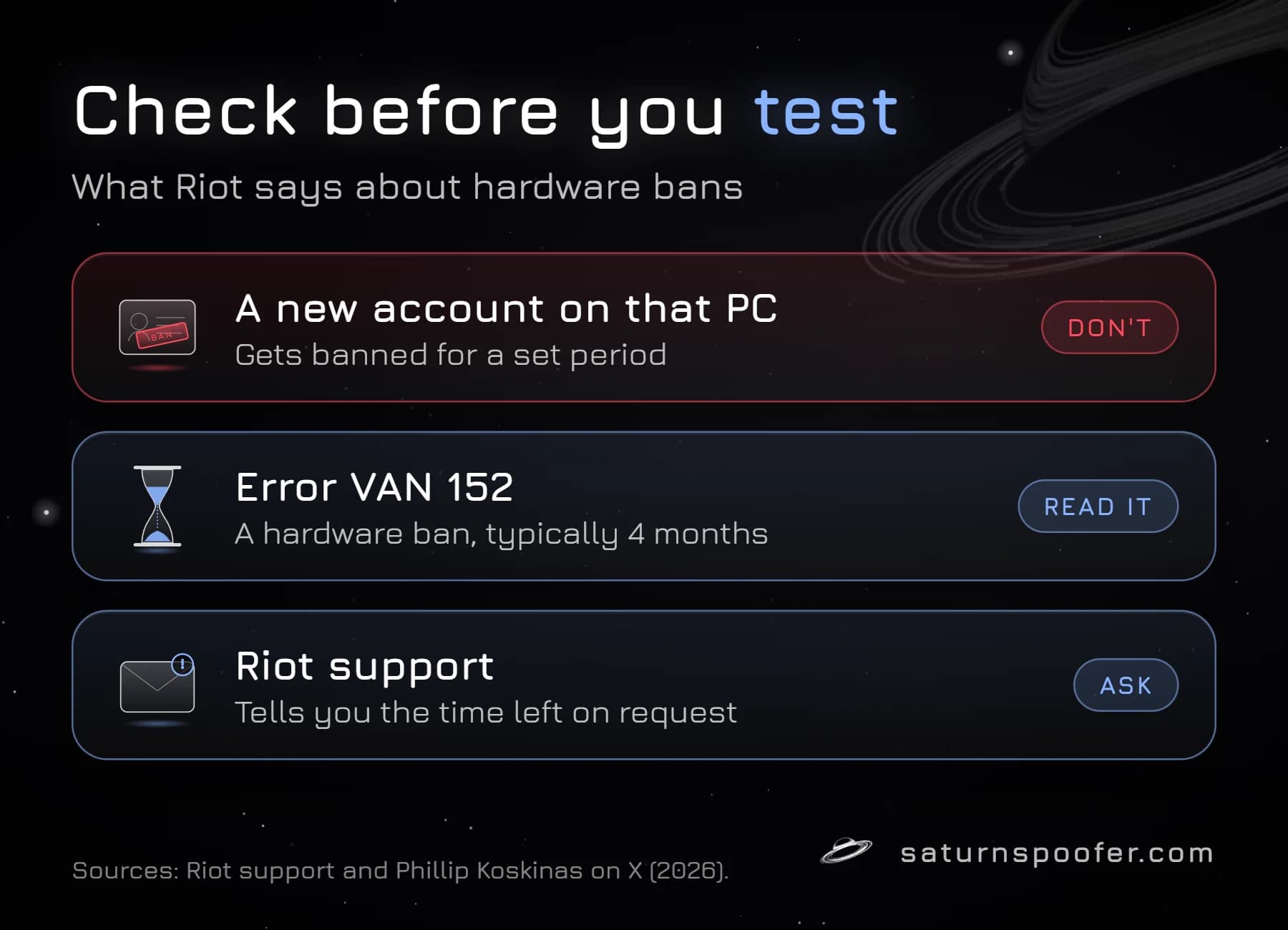
DON'T TEST IT WITH A NEW ACCOUNT It's the first idea most people have, and on Riot games it costs you. Riot's HWID ban article, which I re-read on October 12, 2026, says any other account that logs in on a hardware-banned PC gets restricted on that device and banned for a set period. Riot treats the login as dodging the original ban.
These three checks are safer, and I'd run them in this order:
- Read the error code. Most anti-cheats show a specific code that separates account bans from machine bans. On Valorant, a Valorant HWID ban shows as VAN 152, which Riot's error list says typically lasts four months, while Valorant's VAL 5 error means the account was logged in somewhere else, not a ban.
- Read the ban notice. The email or in-game message usually says whether the account or the device was actioned.
- Ask support. Phillip Koskinas, who works on anti-cheat at Riot, said on X on October 2, 2026 that support will tell you the time left on a hardware ban when you write in.
There's a fourth case: both at once. An account ban and a hardware ban issued together look the same at login, and clearing the hardware side leaves the account side exactly where it was.
You had two bans, and a spoofer only ever claimed to deal with one of them.
You don't need a spoofer when:
- The account is banned and the hardware isn't, which no spoofer can change.
- The block follows your connection, not your PC, which is a network problem rather than a hardware one.
- An appeal is still open, because a pending review is worth more than a workaround and dodging a ban while a ticket is open doesn't help the ticket.
You do need one when the PC is blocked whatever account you use, the hardware carries the ban, and you've accepted that running a spoofer breaks the game's terms.
Error code first. Spoofer second.
How Saturn Fits Into This Category
Saturn is a kernel-mode HWID spoofer for Windows, and we build it to run from one loader, with the license you hold deciding which anti-cheat systems it covers.
We sell five licenses: Vanguard, EAC, BattlEye, Javelin and ACE, with FiveM inside the BattlEye license. Between them they cover 61 games, and each system has its own page listing them: the Vanguard HWID Spoofer, EAC Spoofer, BattlEye Spoofer, EA Javelin HWID Spoofer and ACE Spoofer.
Our spoof list covers the CPU, TPM, motherboard and SMBIOS data, RAM, NVMe, SSD and HDD drives, GPU, monitor EDID, MAC address, USB devices and UEFI variables, plus the Windows volume serial and MachineGuid.
Saturn runs in two modes. Temporary mode gives you unlimited profiles and puts your original IDs back when you close it. Permanent mode writes one profile to the PC for good, and if that profile gets banned, you buy a new one. Our setup guide covers the Windows settings to check first, including Secure Boot, TPM and memory integrity.
The two-minute demo below shows the whole run on Windows for Riot Vanguard games, from opening the loader to starting the game.
Where it falls short is everything in the limits sections above: we change hardware IDs, and Saturn doesn't unban an account, hide your IP or promise to get past every future anti-cheat update.
Every license comes with a 24-hour free trial that needs no card, only an email address for the key. In a category full of claims you can't check, testing on your own PC with your own game is the only test I'd trust.
HWID Spoofer FAQ
What is an HWID spoofer in simple terms?
An HWID spoofer is a program that makes your PC report different hardware serial numbers from the real ones. Games that ban hardware recognize PCs by those serials, so changing what gets reported changes whether your PC looks like the banned one.
Is an HWID changer the same as an HWID spoofer?
Yes, HWID changer is another name for an HWID spoofer, since both change the IDs your hardware reports. An HWID cleaner is different: it deletes leftover files and registry entries without changing any IDs, so it can't clear a hardware ban on its own.
Does an HWID spoofer change my actual hardware?
No part is physically changed. A temporary spoofer writes nothing to firmware, so only the answer software gets is different, while a permanent spoofer rewrites stored values such as the motherboard serial, which is why its change survives a restart.
Can I get my original HWID back after spoofing?
After a temporary spoofer, yes, because closing it brings your real IDs back. After a permanent spoofer there's no reliable undo: a clean Windows install plus a BIOS reset or reflash can help, but no tool guarantees your original IDs come back.
Can an HWID spoofer break Windows activation?
It can. Microsoft ties your Windows digital license to your hardware, and after a large hardware change Windows may not find a matching license, which is why linking your Microsoft account to the license matters. Users have also reported streaming apps failing after running a spoofer.
Will a spoofer unban my account?
No. Account bans are records on the publisher's servers, tied to your login rather than your PC, and a spoofer can't reach them. If your account and your hardware are both banned, clearing one leaves the other in place.
Does reinstalling Windows remove a hardware ban?
No. A clean install rebuilds the registry and gives your drive a new volume serial, but the motherboard, CPU, disk firmware and network card keep reporting the same IDs, and those are what a hardware ban is built on.
Are HWID spoofers against the terms of service?
Yes, for nearly every game that issues hardware bans, because getting around a ban breaks the terms you agreed to. The realistic cost is losing accounts rather than legal action, but it's a real risk, not a technicality.
Why do free HWID spoofers get warned about so often?
Because the access a spoofer needs is the same access malware wants. Running an unknown kernel driver hands full control of your PC to whoever wrote it, and a free tool shared on a forum or Discord server comes from someone you can't check.
Does one spoofer work against every anti-cheat?
No. Vanguard, Easy Anti-Cheat, BattlEye, EA Javelin Anticheat and Anti-Cheat Expert each read your PC differently, and a tool built for one isn't automatically effective against another, so check which system protects your game first.
How can I tell whether my ban is hardware-level or account-level?
Read the error at login and the ban notice. On Riot games, VAN 152 means the PC is banned, not the account. Don't test it by logging in with a new account, because Riot bans accounts that sign in on a hardware-banned PC.
Final Thoughts
An HWID spoofer does one job: it changes the IDs your PC reports, so a hardware ban stops matching your machine, and it leaves accounts, IP addresses and cheat detection exactly where they were.
My advice is to find out which ban you have before you buy anything. If it's the PC, a spoofer is the tool for that job, and if it's the account, it isn't, which I'd rather you heard from me now than found out after paying.
Checked by Gabri on October 12, 2026. Sources: Riot's HWID ban article and VALORANT error list, Phillip Koskinas on X (October 2, 2026), Riot's Vanguard on-demand announcement (June 2026), Microsoft's Windows reactivation guide and GetVolumeInformation docs, two Microsoft Q&A threads (August 26, 2023 and July 20, 2025), Epic's Hardware Identifiers Warning (read September 29, 2026), the README of an open-source DMA spoofer on GitHub, and Saturn's own spoof list. The Q&A threads are user reports, not Microsoft statements.