 Gabri
Gabri
A Valorant HWID ban is a hardware-level ban: Riot flags the PC itself, and every Riot account that logs in on it hits error VAN 152 until the ban runs out. Riot's VAN 152 page, last updated July 16, 2026, says no reinstall, restart or network change removes it. Expect four months for a standard ban, and longer after repeat or severe violations.
Valorant HWID bans aren't permanent by default, a fresh account makes things worse, and reinstalling Windows changes nothing Riot checks. What's left is a re-evaluation request to Riot, or software that changes what your PC reports.
What Is a Valorant HWID Ban?
A Valorant HWID ban is a penalty on the machine rather than the login. Riot Vanguard, the anti-cheat Valorant runs on, matches the PC's hardware identifiers against the ban, so switching to another Riot account on the same computer changes nothing. Riot Games' own support article on HWID bans calls it "a drastic step we take against players who've consistently chosen not to adhere to our Community Pact or to abide by our terms of service."

Whether the ban reaches past Valorant depends on which Riot statement you go by. Riot's HWID article, dated May 31, 2026, frames a hardware ban as keeping the player off "any account on a Riot platform or game." On October 2, 2026, Riot anti-cheat lead Phillip Koskinas said hardware bans "apply only to the game cheats were detected in," so a Valorant cheat ban points to Valorant alone. A League of Legends HWID ban follows the same rules on the League side, down to the VAN 152 error at login.
How Long Does a Valorant HWID Ban Last?
Four months is the standard length of a Valorant HWID ban. Riot's VALORANT error code list, updated June 2, 2026, describes VAN 152 as "a hardware ban which typically lasts 4 months." It runs longer for repeat offenses and severe violations, and bans handed out for "a verifiable threat of harm against a player or Rioter" are ones Riot refuses to consider lifting. Riot's HWID article, last updated May 31, 2026, gives no fixed length and says the ban can be re-applied if the behavior returns.
Riot's pages don't match, which is part of why guides disagree: you'll see 90 days, 120 days and a one-year wait before appeals quoted as rules. The error list is the only Riot page we found that puts a number on the ban. The HWID article sets no waiting period before you ask for a review.
Don't spend those months testing the ban. Each extra account you sign into on that PC picks up a ban of its own, and when Riot reviews an HWID ban it can decide to extend it instead of lifting it. Leave the machine off Riot's games until the four months are up.
Does Valorant Use HWID Bans?
Yes. Valorant uses HWID bans through Riot Vanguard, the kernel-level anti-cheat that has shipped with the game since its 2020 launch, and Riot's HWID article lists three routes to one:
- Abusive chat or deliberate feeding, carried on across many permabanned accounts
- A verifiable threat of harm aimed at other players or at Rioters
- Getting flagged for third-party tools such as scripts and cheats
Most bad behavior stops short of that. Riot's VALORANT Penalties and Bans FAQ, updated June 2, 2026, lists the account-level penalties that come first: XP denial, Rank Rating deductions, teamplay restrictions and game bans that last anywhere from 7 days to permanent. A hardware ban sits above all of those. For toxic players it arrives after the account bans stop working, while for cheating, such as running Valorant aimbot or ESP cheats, a single flag can be enough. Players also describe a quieter "shadow ban", where matchmaking seems to change with no notice from Riot.
How to Tell If Your HWID Is Banned on Valorant
The clearest sign of a Valorant HWID ban is error VAN 152 on every login from the same PC, whichever Riot account you use. According to Riot, "any login attempt will result in a VAN 152 error code," and a second account signing in on that machine gets restricted, with a ban "for a set period" to follow. Riot's VAN 152 support page is explicit that the code isn't an install or connection fault, so troubleshooting won't make it go away.
Don't confirm it by creating a fresh account. Some guides still suggest registering a new Riot ID to see what happens, but on a hardware-banned PC that account gets banned as well, and a string of banned alts is the last thing you want on record before asking Riot for a review. Other Vanguard error codes point at problems you can fix yourself, and a VAL 5 code is a different error from VAN 152.
Can You Play Valorant While HWID Banned?
You can't play Valorant on an HWID-banned PC until the ban ends: every account on it hits VAN 152, and Riot bans each extra account for a set period. A different PC doesn't fit Riot's rules either, because Riot's HWID article aims the ban at you as a player, not at one machine. The usual workarounds, and what each one does:
| What you try | Does it lift the ban? | Why |
|---|---|---|
| A new Riot account on the same PC | No | Riot restricts it, then hands it a ban of its own |
| Reinstalling Valorant or Riot Vanguard | No | Riot's VAN 152 page rules out both |
| A factory reset or reinstalling Windows | No | The hardware identifiers behind the ban stay the same |
| A VPN | No | It changes your IP address, and this isn't an IP ban |
| Playing on a friend's or a second PC | Not within Riot's rules | Riot aims the ban at you, not just at the PC |
| A re-evaluation ticket | Sometimes | Riot calls a lift possible but never guaranteed |
| Replacing parts | Unclear | Riot doesn't publish which identifiers it uses |
| An HWID spoofer | No, it changes what the PC reports | Riot's ban record doesn't change, and using one breaks Riot's Terms of Service |
The VPN row is where Valorant IP bans and hardware bans get mixed up: a VPN changes the IP address your PC connects from, while Riot Vanguard keeps matching the same hardware identifiers.
How to Get a Valorant HWID Ban Lifted
A Valorant HWID ban comes off early only through a re-evaluation: a player support request that Riot investigates before deciding to lift or extend the ban. Riot calls a lift "possible (but never guaranteed)" and wants a separate ticket for each affected account. Threat-of-harm bans are excluded.
- Open Riot's ticket form and pick the request type for bans and penalties.
- Use Riot's own wording and request "a re-evaluation of the HWID ban," with the Riot ID of the affected account.
- Send one ticket per affected account so each gets its own review.
- Stick to facts: when VAN 152 first appeared, what happened before it, and anything that backs you up, like a receipt for a second-hand PC.
- Keep other accounts off that PC while the review runs.
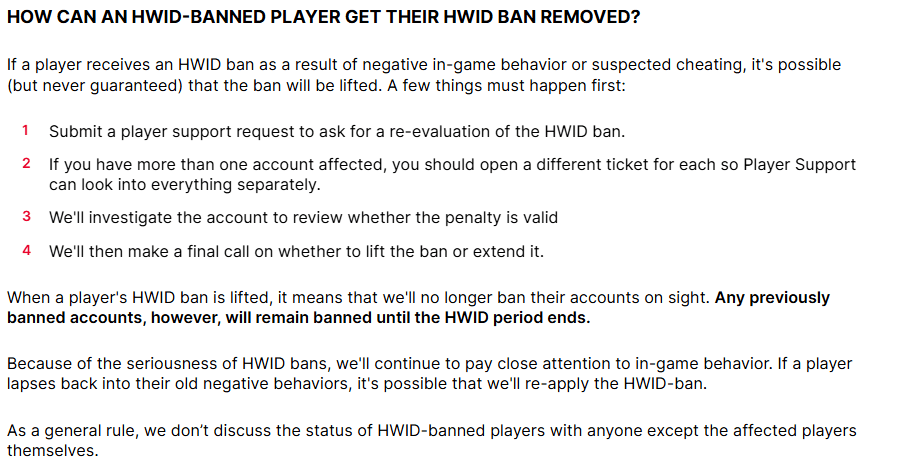
If Riot lifts the ban early, it stops banning your accounts on sight, but any account already banned stays banned until the original HWID period runs out. Riot routes Valorant reviews through the same Player Support system as its other games, so a Valorant ban appeal for VAN 152 is a standard ticket built on the Riot ID, the date the error first appeared and your evidence.
Bought a Used PC With a Valorant HWID Ban?
A Valorant HWID ban can come with second-hand hardware. If the PC or motherboard you bought belonged to someone Riot banned, VAN 152 can appear on your very first login, and Riot's rules treat your account like any other account on a banned PC, restricting it first and banning it for a set period after.
There's no public tool for checking a PC or part before you buy, because Riot doesn't offer one. The protection is practical. Buy from sellers that take returns, and if VAN 152 shows up in the first days, send the hardware back or file a re-evaluation ticket straight away with your receipt and the purchase date. Say plainly that you're the new owner. Riot promises nothing. But a dated receipt is the kind of evidence a review can use.
If you're sure a ban on your own Riot account is a mistake, treat it as a Valorant false ban and gather your evidence before you write in.
Playing Valorant Again on the Same PC
Getting back into Valorant on a hardware-banned PC while the ban still runs means changing what that PC reports to Riot Vanguard. New parts are one way, but with no public list of the identifiers Riot bans, buying hardware is a gamble. The other way is HWID spoofing, where software alters the identifiers Vanguard reads so the machine stops matching the one Riot banned. Spoofers also differ in whether the change outlasts a restart, which is the line between a perm spoofer and a temp one.
Saturn is a Windows HWID spoofer, and Valorant falls under its Vanguard product. A single Vanguard license covers Valorant, League of Legends and Teamfight Tactics from one loader, with no Windows reinstall as part of setup. It spoofs the identifiers for the CPU, TPM, motherboard, RAM, drives, network adapter, GPU, USB devices and monitor. Saturn lists the current status of its Valorant HWID Spoofer next to the Vanguard plans, while the free 24-hour trial takes an email address instead of a card.
Weigh the trade before you go this way. A spoofer doesn't unban anything: Riot's record of the ban and the bans on your old accounts all stay. You also need a Riot account with no permanent ban of its own. Playing through an HWID ban is itself a Terms of Service breach. Riot counts any account played on a banned machine as an evasion attempt, so a spoofer that gets detected can cost you the account you're using.
When a PC still gets flagged after a normal setup, Saturn's last-resort fix is a fresh start on a clean Windows install, done step by step.
Valorant HWID Ban FAQ
Is a Valorant HWID ban permanent?
A Valorant HWID ban isn't permanent by default: Riot's error list says the hardware ban typically lasts four months. It gets longer for repeat or severe violations and can be re-applied if the old behavior returns. Threat-of-harm bans don't come off at all.
Does a factory reset remove a Valorant HWID ban?
No. A factory reset rebuilds Windows, and a Valorant HWID ban is tied to identifiers in the hardware that a reset leaves alone. Riot also rules out reinstalling Valorant or Vanguard as a fix.
Does a Valorant HWID ban block League of Legends too?
Usually not, for a cheat ban. Riot anti-cheat lead Phillip Koskinas said on October 2, 2026 that hardware bans apply only to the game the cheats were detected in. Riot's HWID article still describes a wider ban that keeps the player off any Riot game, so the scope depends on which ban Riot applies. When League is blocked, it shows the same VAN 152 error.
Is there a Valorant HWID ban checker?
No. Riot doesn't publish a Valorant HWID ban checker, and third-party "checkers" can't see Riot's records. The check that counts is error VAN 152 at login. For anything beyond that, ask Riot through a support ticket.
Can I play on a friend's PC during a Valorant HWID ban?
Not within Riot's rules. Riot aims an HWID ban at the player rather than the machine alone, so moving to someone else's computer during the ban still goes against its terms.
What happens to my accounts when the ban ends?
Accounts banned during the HWID period stay banned until that period is over, even if Riot lifts the hardware ban early after a review. Once the ban ends, Riot stops banning logins from that PC on sight, and any account that was permanently banned in its own right stays that way.
Does an HWID spoofer lift a Valorant HWID ban?
No. A spoofer only changes the hardware details Vanguard reads from your PC. Riot's ban record, and every account banned under it, stays where it was, and using a spoofer while banned breaks Riot's rules.