 Gabri
Internal cheats run inside a game's own process, external cheats run as a separate program that reads the game from outside, and DMA cheats push that reading onto a second computer through a hardware card.
Anti-cheat makers sort cheaters the same way. In an anti-cheat update dated June 24, 2026, Riot Games put cheaters in about 0.7% of PC ranked matches in League of Legends and Valorant, and said cheats that drop a library into the game client now make up under roughly 10% of those infected matches.
On November 18, 2026, I read Riot's anti-cheat posts from February 2025 and June 2026, Riot's hardware ban article, Microsoft's Learn article on the two Windows processor modes, BattlEye's own site and a June 2026 research paper on screen-reading aimbots. Below: what each cheat type is, how anti-cheats catch each one, why "external" doesn't mean safe, and what a ban costs you whichever type you ran.
Lost a PC to a hardware ban and want it back in the game? Skip down to the HWID spoofer section. Here to understand how cheat types differ? Saturn isn't your answer, so carry on reading from here.
What Is the Difference Between Internal and External Cheats?
The difference between internal and external cheats is where the cheat's code runs: inside the game's process, or in a program of its own beside the game.
That one line has grown into five types as cheat makers moved further and further away from the game. Each move put the code somewhere new.
And each place has its own anti-cheat answer, which is the part you need if you're trying to understand bans.
| Type | Where it runs | What anti-cheats watch |
|---|---|---|
| Internal | Inside the game | Foreign code in the process |
| External | A separate program | Access to the game from outside |
| Kernel | Inside Windows | Vulnerable drivers, boot state |
| DMA | A card and a second PC | The PCIe device, IOMMU |
| Screen-reading | The pixels on screen | Inputs and aim data |
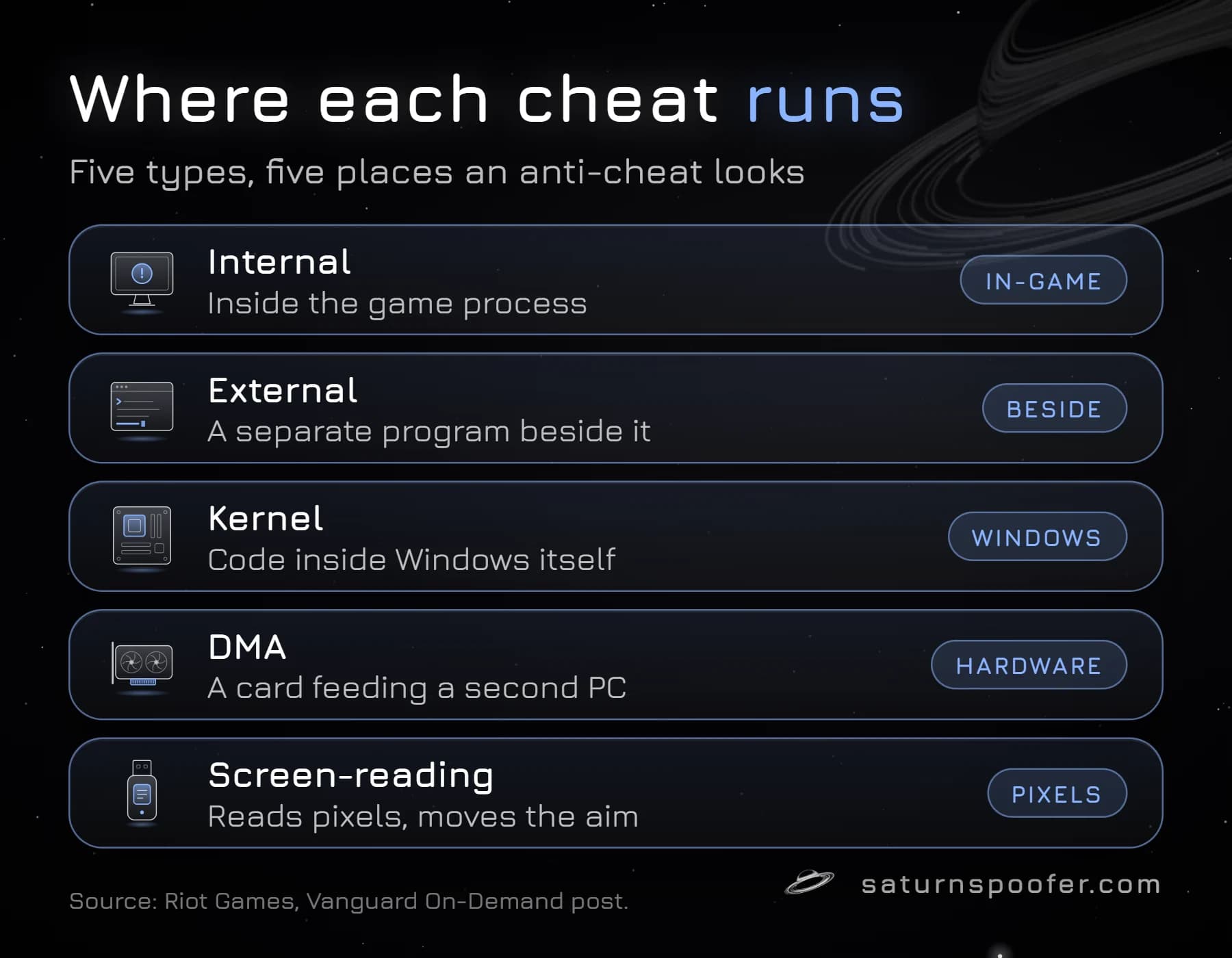
Sellers rank these types by which scans each one dodges. I'd rank them by what the anti-cheat makers say they catch, because that's the list that decides whether you keep your account.
What Is an Internal Cheat?
An internal cheat is code that runs inside the game's own process, so it can read and change game memory from the same place the game itself does.
Riot's June 2026 post defines it as a cheat that "makes use of a legitimate-looking library to manipulate game memory."
Being inside the game is the appeal. Everything the game knows sits right there for you, from player positions to health values, with no wall in between.
It's also the weak point. Foreign code inside your game is the first thing an anti-cheat looks for, and Riot says most multiplayer games already check for libraries in their application "that shouldn't be there."
Riot Vanguard goes further. Riot says its driver limits what user-mode programs can do to the game client and turns it into a protected process, which Riot credits with knocking internal cheats out as a class. Cheats that load a library into the client are either blocked outright under Vanguard or found fast, according to the same post.
Riot's own numbers show the result. Internal cheats make up a small slice of the cheating Riot sees, and if you still use one, Riot's post files you with the players "addicted to bans."
What Is an External Cheat?
An external cheat is a separate program that runs next to the game and gets its information from outside the game's process, usually by reading the game's memory and sometimes by reading the screen instead.
On Windows, that's harder than you'd think. Microsoft's Learn article on user mode and kernel mode explains that every app in user mode gets its own private virtual address space, so "one application can't modify another application's data."
An external cheat has to get past that separation before it can show you anything at all.
Against a game with a kernel anti-cheat, a normal program doesn't get far. That's why so many external cheats lean on a kernel driver of their own, which turns them into the next type on this page.
You've probably seen external cheats sold as the careful option. The anti-cheat makers' own posts don't back that up, and the next three sections show you why.
What Are Kernel Cheats?
Kernel cheats are cheats that get some or all of their code into the Windows kernel, the most privileged layer of the system, so they run underneath the game and underneath any anti-cheat that only lives in user mode.
Riot's June 24, 2026 post, Vanguard On-Demand, describes a kernel cheat as one that uses a kernel vulnerability to run unsigned code at the operating system's level. From there, Riot says, a cheat driver can intercept the requests a user-mode anti-cheat makes to the kernel and blind it completely.
That's the reason kernel-level anti-cheat drivers exist at all. Riot says most competitive games install a driver component to level the field, and BattlEye describes its own product as a "fully proactive kernel-based protection system."
It's also why kernel cheats are the most common kind in Riot's data. DMA and screen-reading cheats usually need extra hardware you'd have to buy, so Riot says kernel-level cheating remains the most popular route in its PC games.
How Vanguard Answers Kernel Cheats
Vanguard, Riot's kernel anti-cheat, starts its driver when your Windows starts, so a vulnerable driver can't load a cheat first and then hide. Riot says Vanguard holds a local blocklist listing the drivers cheaters favor, and if one of them appears, Vanguard unloads and Riot knows the system is no longer secure.
What a Kernel Cheat Costs Your PC
A kernel cheat asks more of you than a game ever should. Riot says cheaters are willing to switch off Windows security features to run one.
Microsoft's page notes that code in kernel mode isn't isolated, so one kernel driver crash brings down the entire operating system.
A kernel cheat trades the game's view of your PC for Windows' view of it, and the protections it needs switched off are the same ones guarding everything else on that machine.
DMA and Screen-Reading Cheats
DMA and screen-reading cheats are the two types that try to keep cheat software off the gaming PC: one reads memory through hardware, and the other reads pixels.
DMA Cheats
A DMA cheat relies on a PCIe card with direct memory access to copy the game's memory over to a second computer, which runs the cheat and pulls enemy positions out of what it receives. Riot says this is "usually for wallhacking," and the same DMA cheat hardware shows up in other shooters, each with its own anti-cheat response.
DMA counts as external in the sense that matters: nothing runs inside the game, and the main software doesn't run on your gaming PC either. That distance is the whole pitch.
The distance doesn't make you invisible. Riot's Vanguard On-Demand post says it spent the year before that post forcing full IOMMU limits onto Valorant cheaters at high ranks who abuse DMA. The IOMMU sits between devices and RAM, and once Riot marks game memory as unreadable, the card's request throws a hardware fault instead of returning data.
Screen-Reading Cheats
A screen-reading cheat, which Riot calls a pixelbot, looks at the picture on screen for enemy outlines or colors and then aims or fires for the player. It never opens the game's memory, which is its selling point.
Here the labels flip on you. Riot's 2026 post says pixelbots come in "external" (hardware microcontroller) and "internal" (python script) varieties, so the same words describe where the input comes from rather than where the code runs.
Researchers take the threat seriously. A paper on arXiv dated June 2, 2026 says visual aimbots, the AI version of aimbots that read the screen, sit out of reach of commercial kernel-level anti-cheats, because they work from screen captures instead of game memory. The same authors then catch them another way, with in-game image patches that set off the cheat's detection model, and report over 90% detection in their controlled tests.
Riot attacks the other end. Its February 4, 2025 post says Vanguard already throws away input coming from anything but your primary peripheral, so a pixelbot needs a workaround before it can move your aim. Some pixelbots skip aiming altogether and pull the trigger when an enemy crosses the crosshair, which Riot points out is a triggerbot by another name.
Staying out of memory doesn't keep a pixelbot off the server, though: every shot it lines up for you still lands in the record of how your account aims.
How Do Anti-Cheats Detect Each Type?
Anti-cheats detect each cheat type at the layer it uses: inside the game process, in the Windows kernel, at the hardware, in your inputs and in the match data on the server.
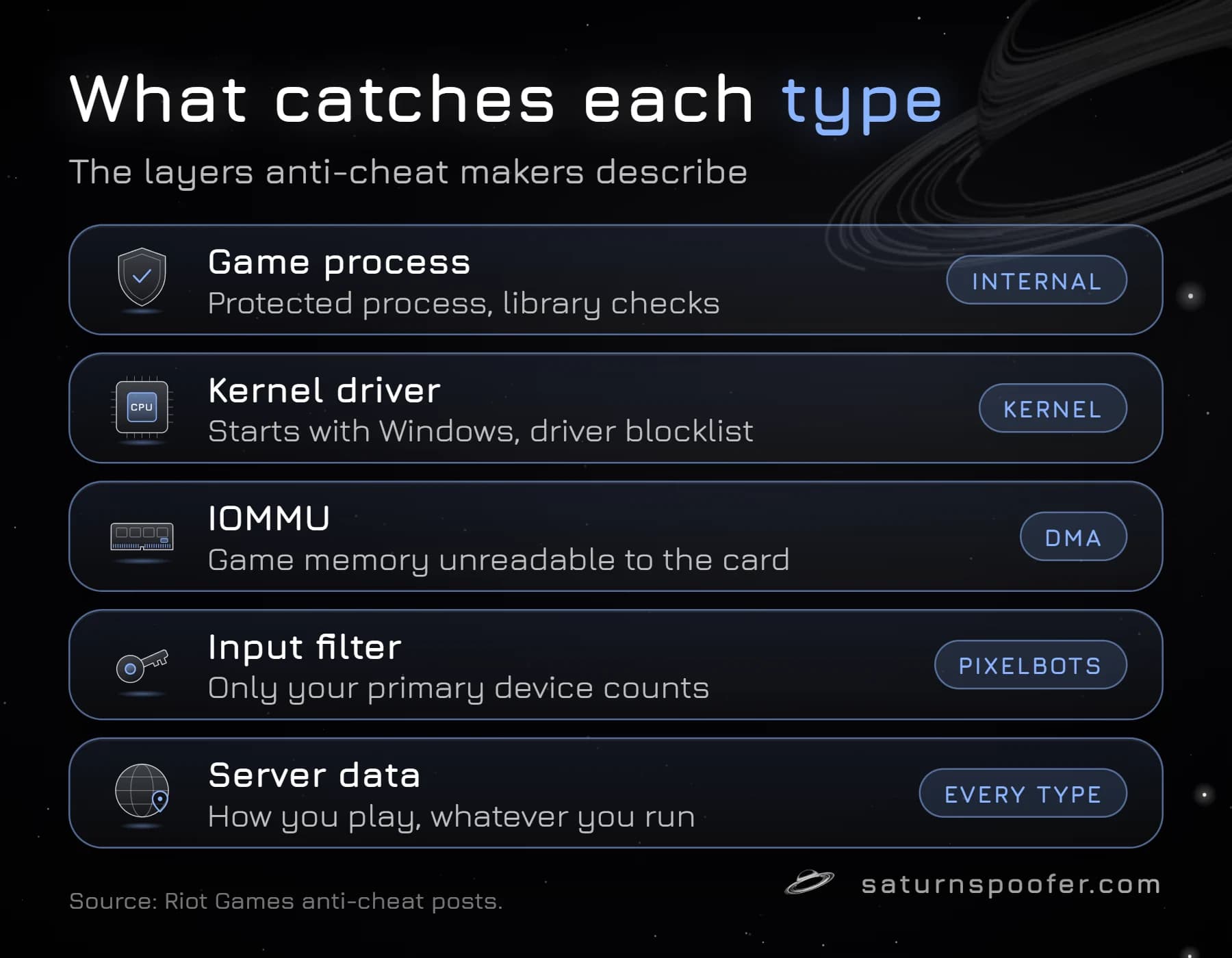
- The game process. Vanguard runs the client as a protected process, and most multiplayer games scan for libraries and files that shouldn't be there. This is where internal cheats die.
- The kernel. A driver that starts with Windows, plus a blocklist of the vulnerable drivers cheaters rely on. This is the layer aimed at external and kernel cheats.
- The hardware. IOMMU enforcement stops a DMA card from reading game memory in Riot's games.
- The inputs. Vanguard rejects input that doesn't come from your primary peripheral, which is where hardware pixelbots get stuck.
- The server. Riot's behavioral detection for Valorant uses only in-game performance data, so it catches you by how you play, not by what you run.
That last layer is why Riot's own charts can't always name the cheat type. Riot says behavioral detection mostly removes blatant cheaters, and because it works from performance data alone, those matches get their own category instead of a cheat type.
The server layer is the one no build type escapes, because every cheat, wherever its code runs, still has to change how you play.
Are External Cheats Safer Than Internal Cheats?
No. External cheats skip one kind of check, the scan for foreign code inside the game, and then run into all the others: the kernel driver, the hardware checks, the input filter and the server.
Riot's data points the opposite way from the sales pitch. The kernel cheat, the type so many external cheats lean on, is the one Riot calls the most popular and built Vanguard to fight.
BattlEye takes the same line on private hacks. Its site says it patches new exploits "as quickly as possible" and permanently bans the cheaters who still get through.
I'd read "external" as a description of where the code runs, never as a promise about your bans. The same goes for your PC: the further a cheat reaches into Windows, the more of your machine it asks you to hand to a stranger.
External changes where a cheat gets caught. It doesn't change whether it does.
What a Cheating Ban Costs, Whatever the Type
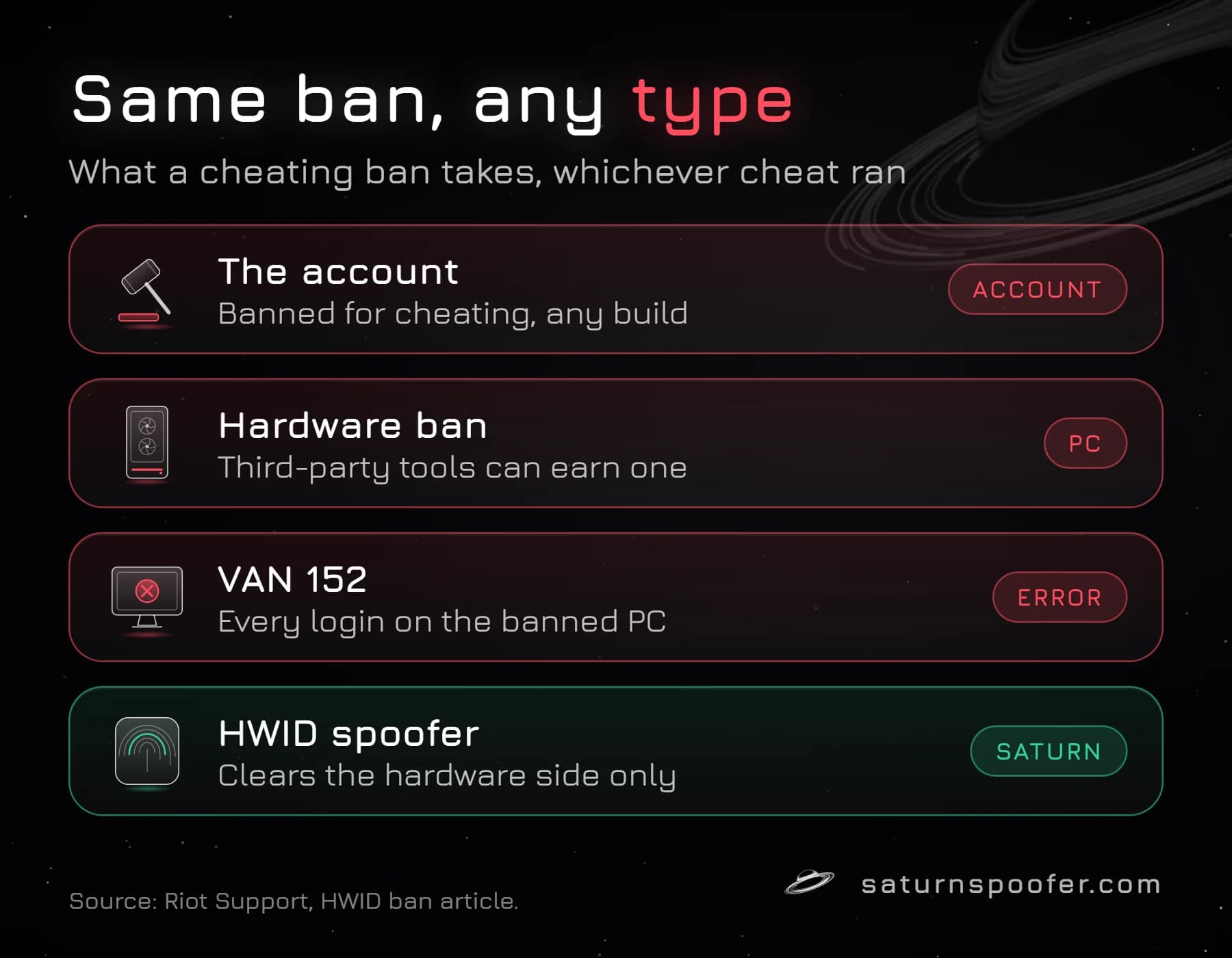
A cheating ban costs you the same whichever cheat type set it off: your account goes first, and in games that use hardware bans your PC can go with it.
Riot's article on hardware ID bans, last updated May 31, 2026, lists a player "flagged for using third-party tools (scripting or cheating)" among the reasons for one. When it lands, Riot says it has banned the physical components of the computer, every login attempt returns error VAN 152, and any other account used on that PC gets restricted on it too.
Nothing in that article asks how your cheat was built. An internal cheat, an external one and a DMA card all count as third-party tools.
Riot's anti-cheat data adds one more detail: "tampering" in its charts most often means "cheaters trying to bypass their hardware suspensions." A banned PC is something Riot keeps checking for, not something it forgets after the first ban.
BattlEye works at a different level. Its site describes global bans that can be account-based, including bans across Steam, so a cheat type that worked for you yesterday still costs you the account the day it's caught.
Where Does an HWID Spoofer Come In?
An HWID spoofer comes in at one point on this page: a cheating ban that reached your PC's hardware, when you want that machine able to play again.
That's the job we build Saturn for, and we don't build cheats. A spoofer rewrites the identifiers Windows hands to an anti-cheat, with the motherboard, CPU, TPM, disks, GPU, MAC address and monitor serials among them. That's how HWID spoofers change those serials so a hardware-banned machine reads as different hardware.
It doesn't touch the cheat. It doesn't touch the account. It doesn't touch the match data the server already holds.
Saturn is the wrong answer if:
- New accounts still work on that PC. That points to an account-only ban, and a spoofer has nothing to fix.
- You believe the ban was wrong. The publisher's appeal comes first.
- You were banned on a console. A Windows tool can't reach a PlayStation or an Xbox.
- You hope to keep a cheating account alive. Whatever the cheat type, the next detection costs the next account too.
Where it does fit, our Windows HWID spoofer runs from the same single loader as every other Saturn license, with your license deciding which games it covers. We ship fixes within hours whenever an anti-cheat updates, and Saturn runs with memory integrity, Secure Boot and TPM 2.0 all switched on, so it doesn't ask you to turn off the Windows protections that kernel cheaters disable.
As of November 18, 2026, Saturn is currently undetected by every anti-cheat it supports, and the live status page is where that's tracked day to day. I'd keep one thing straight, though: that's Saturn's own footprint, not your cheat's, and an anti-cheat that catches the cheat still bans the account.
Temporary mode gives you unlimited profiles, and your original IDs come back when you close it, while Permanent mode writes one profile for good.
Where it falls short: Riot's Vanguard On-Demand post counts attempts to bypass a hardware suspension as tampering, so Riot treats a spoofer used to get around its hardware ban as a violation in itself, and your banned account stays banned.
Every license comes with a 24-hour free trial, no card needed, only an email address for the key.
Internal vs External Cheats FAQ
What is an internal cheat?
An internal cheat is cheat code that runs inside the game's process. Riot's definition is a cheat that manipulates game memory through a library made to look legitimate, and its June 24, 2026 data puts those cheats under roughly 10% of infected matches in its PC games.
What do external cheats mean?
External cheats are cheats that run as their own program outside the game's process and read the game from there. Most read memory, often with help from a kernel driver, and some read the screen instead.
Are external cheats detectable?
Yes. Kernel anti-cheats watch for the vulnerable drivers external cheats depend on, Riot had been blocking DMA cards with the IOMMU for a year by its June 24, 2026 update, and server-side behavioral detection catches cheating by how a player performs, whatever the cheat type.
What are kernel cheats?
Kernel cheats put some or all of their code into the Windows kernel, often through a vulnerable driver, so they run below the game and below user-mode anti-cheats. Riot says they're the most popular cheat type in its PC games.
Is a DMA cheat internal or external?
External. A DMA cheat reads memory through a PCIe card and runs its software on a second computer, so nothing runs inside the game. Riot answers it with IOMMU restrictions that make game memory unreadable to the card.
Is a pixelbot an internal or external cheat?
It can be either. Riot's June 2026 post uses "internal" for a pixelbot that runs as a script on the PC and "external" for one that moves the aim through a hardware microcontroller.
Can an external cheat get your PC hardware banned?
Yes, in games that use hardware bans. Riot lists using third-party tools for cheating among its HWID ban triggers, and that article makes no distinction between cheat types.
Does an HWID spoofer hide an external cheat?
No. A spoofer swaps hardware identifiers and nothing else. The anti-cheat and the server still see the cheat, so a cheating account gets caught with a spoofer or without one.
Final Thoughts
Internal cheats run inside the game, external cheats run beside it, kernel cheats run inside Windows and DMA cheats run on a second PC, and anti-cheat makers like Riot and BattlEye now have a layer aimed at every one of them.
Where I land after reading Riot's own data: the build type decides which check a cheat meets first, not whether it gets caught, and the ban you'd get is the same either way. If you're trying to work out which kind of cheater keeps beating you, report the player and let the server data do the sorting.
Checked by Gabri on November 18, 2026. Sources: Riot Games' June 24, 2026 post Incoming: Vanguard On-Demand and its February 4, 2025 post Vanguard Hits New Bans Per Second Record, Riot Support's May 31, 2026 article Understanding Hardware ID (HWID) Bans, Microsoft Learn's User mode and kernel mode page (last updated October 29, 2025), BattlEye's home page, and arXiv 2606.07650, Detecting Aimbot Cheaters in MOGs (June 2, 2026). UNVERIFIED: how anti-cheats other than Vanguard handle DMA hardware today, and the cheat-type split in games outside Riot's, since no other publisher I read breaks its bans down that way.