 Gabri
Anti-cheat is software a game studio ships with an online game to catch cheaters, usually a program on your PC that watches the game plus servers that judge what it finds.
The biggest one runs at a scale that's hard to picture: Easy Anti-Cheat's own site claims more than 200 protected games and over 35 million players a month.
On November 18, 2026, I read what the makers of nine anti-cheats say about their own software: Epic, BattlEye, Riot, EA, FACEIT, Valve, Tencent's Anti-Cheat Expert team, Irdeto and KRAFTON. I also read the anti-cheat labels on six Steam store pages. This page covers what an anti-cheat is, how it catches cheats, where it runs on your PC, whether it's safe and what happens after it flags you.
If a game has already locked your whole PC out after a ban, jump to the spoofer section near the end.
Here to learn what the anti-cheat in your system tray does? Then Saturn isn't your answer, and the page reads best from the top.
What Is Anti-Cheat?
Anti-cheat is a security layer inside an online game whose one job is keeping matches fair: it looks for software, scripts or hardware that give a player an edge the rules don't allow, then reports that player so the game can act.
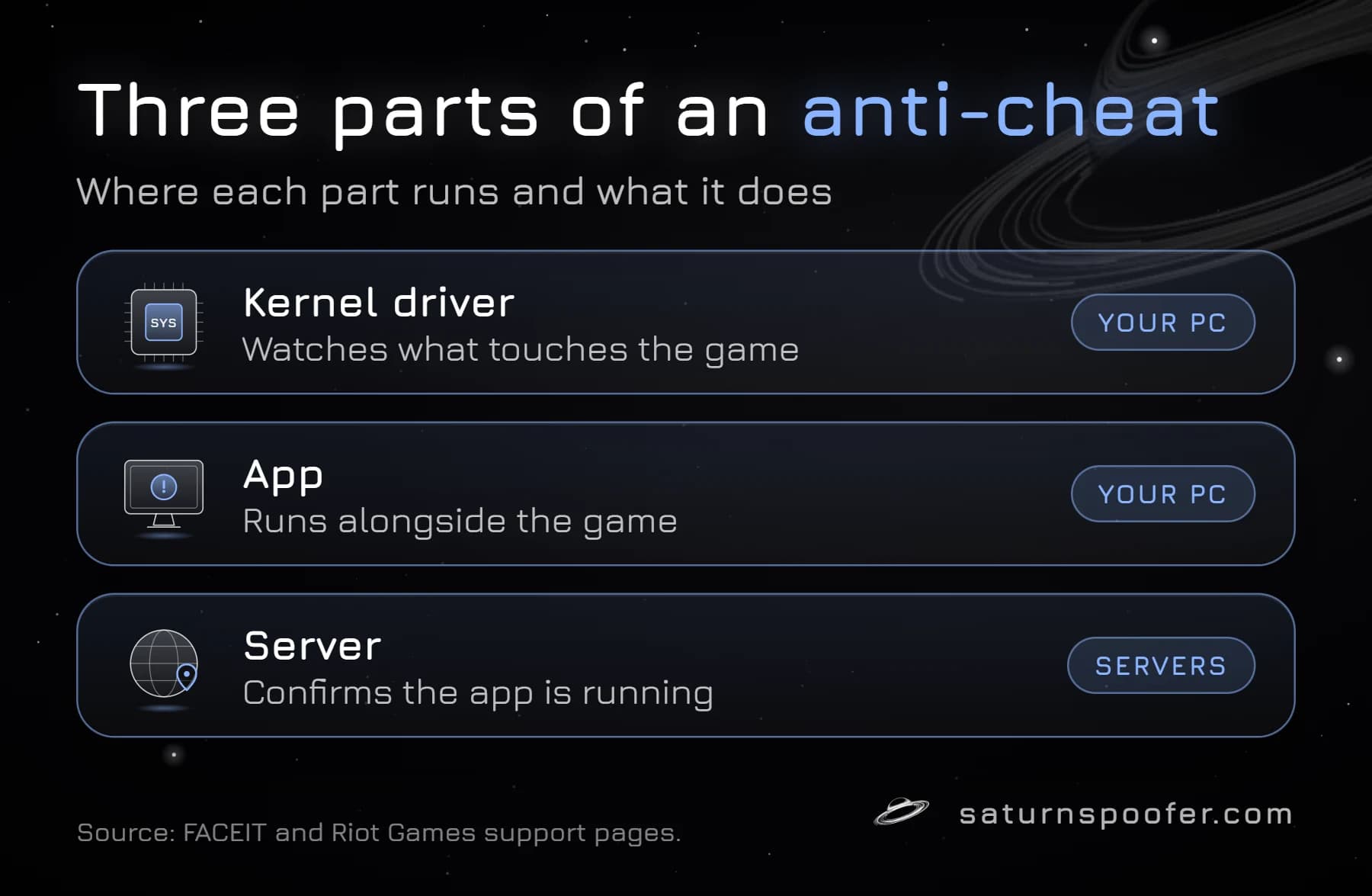
Many modern anti-cheats come in three parts. FACEIT's support page lists exactly these three for its own anti-cheat, and Riot describes Vanguard as the first two:
- The driver. A kernel-mode driver that sits in the deepest layer of Windows and watches what touches the game. FACEIT's driver is "loaded upon PC boot".
- The app. A program that runs alongside the game. FACEIT's has to be running "whenever playing a protected Counter-Strike 2 match", and Riot's Vanguard client runs while Riot's games are active.
- The server. The part you never see. FACEIT's server-side SDK confirms to FACEIT, during each match, that your anti-cheat is running.
Not every anti-cheat has all three. Counter-Strike 2's Steam page says "Uses Anti-Cheat Software: VAC", while games with a driver carry a separate "Uses Kernel Level Anti-Cheat" label.
Anti-cheat isn't the game's copy protection either. Irdeto, which sells both Denuvo products, wrote on July 23, 2020 that Denuvo Anti-Tamper fights piracy, Denuvo Anti-Cheat fights cheating, and the two "don't have much overlap."
How Does Anti-Cheat Work?
Anti-cheat works by comparing what happens on your PC and in your match with what a fair player's game should look like. The makers describe four kinds of check:
- Signatures. Known cheats leave fingerprints in files and memory. Valve's VAC FAQ says VAC "reliably detects cheats using their cheat signatures", much as antivirus software spots known malware.
- Integrity checks. The anti-cheat confirms nobody has changed the game itself. Valve counts edits to "a game's core executable files and dynamic link libraries" as cheating.
- Behavior. Easy Anti-Cheat says it catches cheats using "heuristics, gameplay analysis, and player report signals", so how you play counts, not only what's installed.
- Reports and review. Player reports feed the system, but Valve's FAQ says nobody gets a VAC ban from reports alone.
The server side keeps the checks moving, and BattlEye's homepage says its scanning is "controlled and altered by the backend", which means the checks your PC runs can change without a game patch. BattlEye says that makes a permanent bypass for its client files impossible to build.
Spotting a cheat and punishing it are two different jobs. Easy Anti-Cheat's information page for AI assistants says that once EAC flags an account, it's the game's publisher that chooses whether to suspend or ban it.
That's why an Easy Anti-Cheat appeal can go to the game's publisher rather than to Epic.
Client-Side vs Server-Side Anti-Cheat
Client-side anti-cheat runs on your own PC and can look at the cheat program itself. Server-side anti-cheat runs on the game's servers and only sees what your game sends: where you moved, where you aimed, what your stats look like.
Each side misses things the other catches.
A server has a hard time spotting a wallhack, because a wallhack sends nothing odd. It only shows the cheater more of what the server already sent. A scan on the PC can miss cheats that don't run on the PC at all, and cheats on separate hardware are the clearest case: DMA cheat hardware reads game memory through Direct Memory Access instead of running as software on the PC. EA's September 10, 2026 report lists new anti-DMA protection among its detection updates for the year.
That's why the big games run both, and some run a third front outside the game. KRAFTON's anti-cheat team wrote on November 5, 2026 that it reported more than 280,000 pieces of content selling or promoting cheat programs between January and September 2026.
Kernel-Level vs User-Mode Anti-Cheat
Kernel-level anti-cheat installs a driver in kernel mode, the privileged layer where Windows' own core code runs, while user-mode anti-cheat runs like any other app. Microsoft's driver documentation, updated October 29, 2025, draws the line: each app in user mode gets its own private memory, but all code in kernel mode shares one address space with Windows.
That reach is why studios go there, and EA put the case in one sentence in its 2026 report: "We operate at kernel level because detecting external cheats requires it, not because we want deeper access."
It's also the risk, because the same Microsoft page warns that a crash in a kernel-mode driver takes all of Windows down with it.
Every big anti-cheat on this page except VAC now runs as a kernel anti-cheat, and Steam flags it. Rust's store page reads "Uses Kernel Level Anti-Cheat" beside Easy Anti-Cheat, then adds "Requires manual removal after game uninstall".
Which Anti-Cheat Does Your Game Use?
Your game's anti-cheat is usually named on its Steam store page, in the features box, or in the publisher's support pages if the game isn't sold on Steam. Each maker states when its software runs, and the table below sums up what they say:
| Anti-cheat | Made by | When it runs |
|---|---|---|
| Riot Vanguard | Riot Games | From boot, or on demand |
| Easy Anti-Cheat | Epic Games | Only with the game |
| EA Javelin | Electronic Arts | Only with the game |
| FACEIT AC | FACEIT | Driver from boot |
| Denuvo Anti-Cheat | Irdeto | Competitive modes (2020) |
| BattlEye | BattlEye | Not stated |
| ACE | Tencent | Not stated |
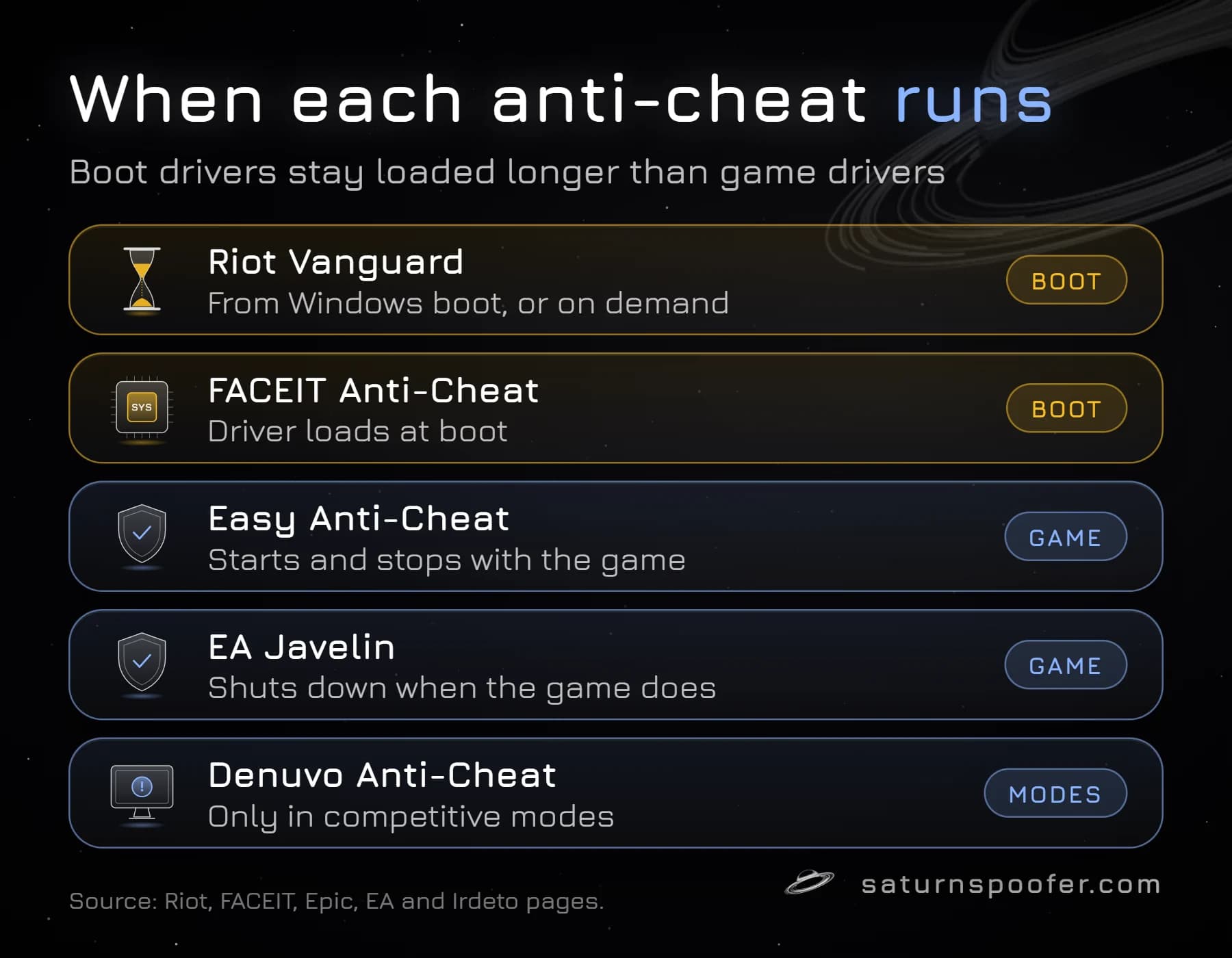
Riot's anti-cheat for VALORANT and League of Legends, Riot Vanguard, is the one that starts with Windows. Riot's support page, dated June 2, 2026, calls it "usually an on-boot application", and only PCs that pass Vanguard Pre-Check can switch it to on-demand.
Epic licenses Easy Anti-Cheat (EAC) to other studios as part of Epic Online Services, and Epic says it starts and stops with the protected game and never runs at boot.
BattlEye's homepage says BattlEye started out in 2004 protecting the Battlefield games as an outside add-on. DayZ's Steam page names it as that game's kernel-level anti-cheat.
Electronic Arts makes EA Javelin Anticheat for its own games, and its September 2026 report counted 20 protected titles and 57.1 million players, with every Javelin process shutting down when the game does.
Tencent's ACE anti-cheat, short for Anti-Cheat Expert and built with Tencent's game security team, is the kernel-level system Steam lists for Delta Force.
Irdeto's Denuvo anti-cheat driver is named on ARC Raiders' Steam page, with the same manual-removal warning Rust carries.
Two more labels round out the big names. PUBG: BATTLEGROUNDS shows KSS (Krafton Security Services) as its kernel-level anti-cheat, and Counter-Strike 2's VAC is the only big name here without a kernel label.
Is Anti-Cheat Safe?
Anti-cheat from a known maker, installed by a game you chose, is safe in the everyday sense: it comes from a company you can name, it installs with the game and you can remove it. Easy Anti-Cheat says outside vendors audit it regularly, and Riot says Vanguard gets internal reviews plus external security audits.
The real risk is the driver itself: code in kernel mode isn't walled off from Windows, so one bug there can crash the PC, and a driver that loads at boot sits on your system for more hours than one that leaves when you quit.
Privacy is the other worry, and three makers spell out what they collect:
- Easy Anti-Cheat. Limited technical data while the game runs, plus hardware identifiers to prevent ban evasion. Detection data is generally deleted within 30 days.
- Denuvo Anti-Cheat. No personally identifiable information, Irdeto said in 2020, only how Windows interacts with the game, sent to Amazon-hosted servers.
- FACEIT. Game and anti-cheat data, and only while Counter-Strike is running.
I found no published source code from any of them, so you're taking each maker's word for it.
I'd keep the anti-cheat for games you still play and uninstall the rest by hand, because Steam's own labels warn that several of these stay on your PC after the game is gone.
What Happens When an Anti-Cheat Catches You?
When an anti-cheat catches a cheat, the usual result is an account ban, and some games go further and ban the PC's hardware.
| Ban | What it blocks | Maker's example |
|---|---|---|
| Account ban | The account that cheated | VAC: "permanent, non-negotiable" |
| Server ban | Play on secured servers | VAC-Secured servers for that game |
| Hardware ban | The PC, by its hardware IDs | EAC collects IDs against ban evasion |
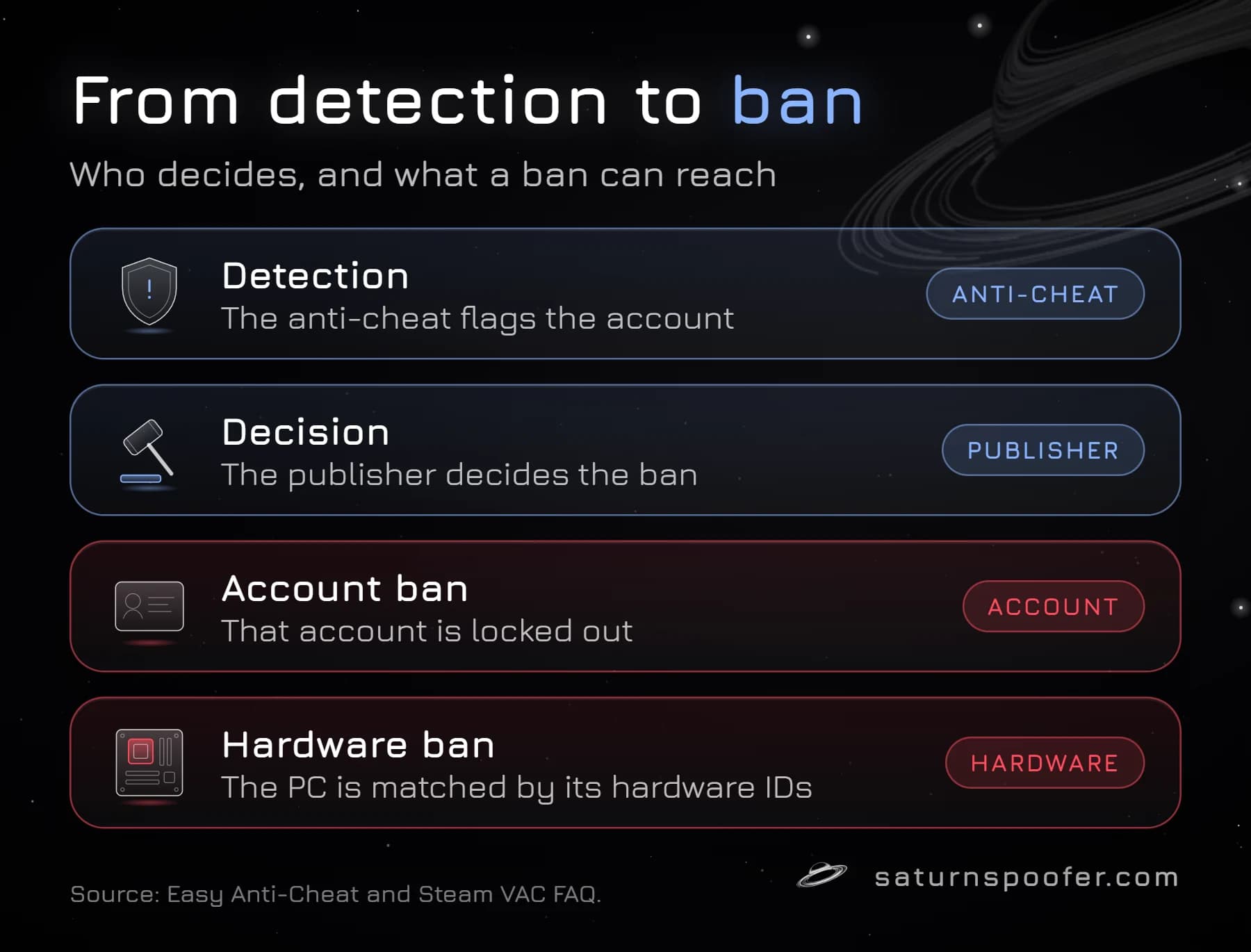
Hardware IDs are the serial numbers and identifiers your parts report, from the motherboard and drives to the network card. An HWID ban is tied to those, so the next account you make on that machine gets caught too.
Valve is the strictest on paper, since its FAQ says VAC bans "cannot be removed by Steam Support", and that a ban found to be issued incorrectly is removed automatically.
If you think the anti-cheat got it wrong, appeal before anything else. Easy Anti-Cheat sends appeals to the publisher or its own appeal form, and EA says it keeps an appeal route open for Javelin bans it got wrong.
Can an HWID Spoofer Help After an Anti-Cheat Ban?
Yes, in one case: an HWID spoofer helps when the anti-cheat's ban reached your PC's hardware, so the machine itself is locked out of a game. It does nothing about the anti-cheat's other jobs.
That's the case Saturn is for. We don't make cheats. Saturn is a Windows hardware ID spoofer that swaps the identifiers your parts report, from the CPU, TPM and motherboard to the drives, GPU, monitor EDID and MAC address, so a PC under a hardware ban reads as different hardware.
It won't hide a cheat from a scan. It won't lift an account ban. It won't change what the server sees of your aim.
Saturn is the wrong answer if:
- A second account still plays on that PC. That's an account ban, not a hardware one.
- The ban is temporary, or you believe it's a mistake. The appeal comes first.
- Your games run on a console, which no Windows program can touch.
- You hope to keep a cheating account alive. Every new detection costs you another account.
Where it does fit, Saturn handles five of the systems on this page: Riot Vanguard, Easy Anti-Cheat, EA Javelin, Anti-Cheat Expert and BattlEye, with FiveM included in the BattlEye license. Our HWID spoofer for those five anti-cheats runs from the same single loader as every other Saturn license, with your license deciding which games it covers.
Saturn runs with Secure Boot, TPM 2.0 and memory integrity switched on, so you don't weaken Windows to use it, and we ship fixes within hours when an anti-cheat updates.
Temporary mode gives you unlimited profiles, and your original IDs come back when you close it. Permanent mode writes one profile for good.
Where it falls short: Saturn changes what your PC reports, not what you do in a match, so a PC that keeps cheating still loses the next account to the next detection.
Every license comes with a 24-hour free trial, no card needed, only an email address for the key.
Anti-Cheat FAQ
What does anti-cheat mean?
Anti-cheat means software built into an online game to detect and stop cheating, such as aimbots, wallhacks and edited game files. It usually has a part on your PC and a part on the game's servers, and the game's publisher usually decides the ban.
Is anti-cheat a virus?
No. Anti-cheat from a known maker, installed by the game, is software from a named company that you can see and remove, which is exactly what malware is built to avoid. The concern people raise is its kernel access, not that it's a virus.
Can anti-cheat see your files?
A kernel driver could technically reach far more of the PC than a game can, so what matters is what the maker says it collects. Easy Anti-Cheat, Denuvo and FACEIT all say they collect game-related technical data, not your personal files, and I found no published code from any of them that would let you check.
What is the difference between VAC and Easy Anti-Cheat?
VAC is Valve's anti-cheat, and Valve's FAQ says it finds cheats by their signatures, with no kernel label on Counter-Strike 2's Steam page. Easy Anti-Cheat is Epic's, licensed to other studios, and Steam lists it as kernel-level on games like Rust.
Does anti-cheat work on Steam Deck or Linux?
Some does. Easy Anti-Cheat lists Windows, Mac, Linux and Steam Deck among its supported platforms, while FACEIT says its anti-cheat has no Mac or Linux version.
Can you uninstall anti-cheat?
Yes, but the game won't run without it. EA says Javelin removes itself once you've uninstalled every EA game that uses it, while Steam warns that Easy Anti-Cheat in Rust, BattlEye in DayZ and Denuvo in ARC Raiders need manual removal.
Can anti-cheat ban your PC?
It can lead to one. The anti-cheat collects hardware identifiers, and a publisher can use them to ban the machine, not only the account. Easy Anti-Cheat says it collects them to prevent ban evasion.
Final Thoughts
Anti-cheat is the part of an online game that hunts for cheats: a driver and an app on your PC, servers that judge what they report, and a publisher that decides the ban. Most competitive games on Windows now run it at kernel level, and the makers say they collect only game-related data, which you can't check for yourself.
Where I land after reading the makers' own pages: keep anti-cheat only for the games you play, check the Steam label before you buy, and appeal any ban you think is wrong before you reach for anything else.
Checked by Gabri on November 18, 2026. Sources: Easy Anti-Cheat's home page and its information page for AI assistants; BattlEye's home page; Riot Games Support, What is Vanguard? (June 2, 2026); EA, Raising the Bar: A Year of Progress for EA Javelin Anticheat (September 10, 2026); FACEIT Support, What is FACEIT Anti-cheat and how does it work?; Steam Support, Valve Anti-Cheat (VAC) System; Irdeto, Keeping the fight fair (July 23, 2020); Anti-Cheat Expert's international site; KRAFTON's PUBG: BATTLEGROUNDS dev letter (November 5, 2026); Microsoft Learn, User mode and kernel mode (updated October 29, 2025); the Steam store pages for Rust, Counter-Strike 2, DayZ, PUBG: BATTLEGROUNDS, Delta Force and ARC Raiders. I installed and ran nothing on a PC for this page. UNVERIFIED: when BattlEye's and ACE's drivers load and unload, since neither maker's page says, and whether Denuvo Anti-Cheat still runs only in competitive modes, as Irdeto said in 2020.