 Gabri
Gabri
The latest Valorant ban wave with a Riot number attached is Vanguard Anti-Boost: on September 17, 2026, Riot said the system had actioned 296,416 accounts for rank manipulation across VALORANT and League of Legends since late 2025. It's one of at least seven waves that Riot or its anti-cheat staff have confirmed since May 2020, when the team banned 8,873 cheaters in the closed beta.
Every wave in the timeline below names the Riot post, or the post by a Riot anti-cheat staffer, that its figure comes from. Numbers we couldn't trace to Riot, including 2026 counts that circulate on other sites, are left out.
What Is a Valorant Ban Wave?
A Valorant ban wave is a group of bans Riot issues at the same moment, instead of banning each cheater as soon as it spots them. Paul "Arkem" Chamberlain, then Riot's VALORANT anti-cheat lead, gave the reason in an August 2020 anti-cheat post: Riot often uses "ban-waves" to keep cheat developers guessing "as to whether or not their cheat is currently detected."
Waves sit on top of everyday bans, not in place of them. Chamberlain wrote that Riot is happy to pull the most disruptive cheaters out early, and Vanguard suspends accounts every day in between. Riot staff use the term for batches of cheating bans and for lockouts of bot-leveled accounts. This page also counts Anti-Boost, Riot's rank manipulation crackdown, because Riot reported its results as one figure.
Valorant Ban Waves Riot Has Confirmed Since 2020
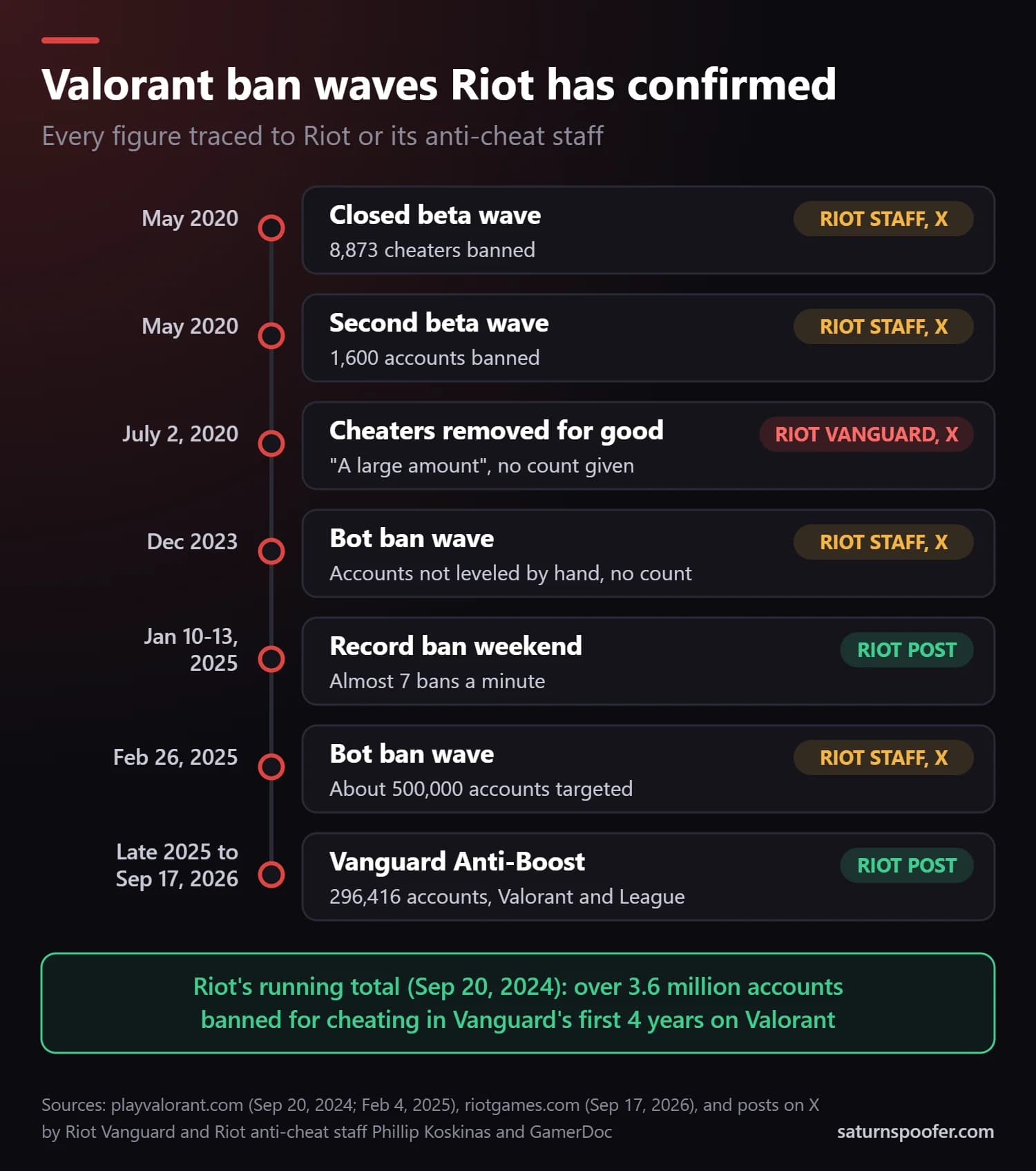
These seven Valorant ban waves have a date or a figure from Riot or its anti-cheat staff. The third column names each source.
| When | Wave and Riot's figure | Source |
|---|---|---|
| May 2020 | Closed beta: 8,873 cheaters banned | Phillip Koskinas on X |
| May 2020 | Second beta wave: 1,600 accounts | Koskinas on X |
| July 2, 2020 | A "large amount" of cheaters removed for good, no count | Riot Vanguard on X |
| December 2023 | Bot wave: accounts not leveled by hand, no count | GamerDoc on X |
| January 10-13, 2025 | Record weekend: almost 7 bans a minute | Riot dev update |
| February 26, 2025 | Bot wave: about 500,000 accounts targeted | GamerDoc on X |
| Late 2025 to September 17, 2026 | Anti-Boost: 296,416 accounts, Valorant and League combined | Riot news post |
The only running total we found is from September 2024. Riot's Vanguard x VALORANT update said Riot banned more than 3.6 million accounts "just for cheating" in Vanguard's first four years on the game, roughly one every 37 seconds. That count leaves out bans for botting, boosting and queuing with cheaters.
Koskinas works on Vanguard and now manages Riot's competitive integrity portfolio, and GamerDoc's X profile describes a staff anti-cheat analyst role on Riot's Vanguard team. Riot put no number on the July 2020 or December 2023 waves. Some sites list Valorant waves month by month through 2026, each with an exact count. None of those counts appear in any Riot post or Riot staff post we found, so they aren't in the table.
Why Does Riot Ban in Waves?
Riot bans in waves to slow cheat makers down. In the February 2025 update linked above, Phillip "mirageofpenguins" Koskinas wrote that blocking a cheat outright gives its maker an instant way to test new versions, and that "the best way to make sure they stay detected is to slow down their iteration by obfuscating and delaying our response."
So a cheat can be detected while its users still think it's safe, and the wave then removes them together. The price is a few games of cheating first. Riot measures that as "time-to-action," and in 2024 the median cheater completed 6 games before the ban, Riot's second-fastest year. Riot also said in February 2025 that, starting in Act 2, every ban would come with a Ranked Rollback that returns the RR other players lost to the cheater.
Is There a Valorant Ban Wave in 2026?
Yes. Riot's headline 2026 figure comes from Vanguard Anti-Boost: by September 17, 2026, Riot said it had actioned 296,416 accounts for rank manipulation across VALORANT and League of Legends since late 2025. Anti-Boost ran privately on League from September 2025 and reached Valorant with Patch 13.01, announced in Riot's Playing Fair update on July 14, 2026. It flags accounts whose rank was earned by a better player logging in, then acts on everyone involved:
- Boosted accounts lose the rank the booster earned and are suspended, for longer with each offense.
- Bought or ownerless accounts are banned outright.
- Boosters with a main account take escalating suspensions on that main as well.
- Hitchhikers who kept queuing with boosters or smurfs lose the rank they picked up.
If Anti-Boost flagged an account you never shared, you can contest it as a Valorant false ban through Player Support.
Three more 2026 changes matter if you're watching for waves.
DMA hardware. In May 2026, a DMA cheat account reported that a Vanguard update had blocked most DMA firmware running over SATA or NVMe, and Riot's official X account quoted that report on May 21 to mock the owners. Koskinas explained the next day that the device isn't bricked: Riot requires IOMMU on accounts using it, "which denies it access to game memory." Riot's Vanguard On-Demand post of June 24, 2026 adds that for the previous year, Riot had been locking high-ranked Valorant cheaters who abuse DMA behind full IOMMU restrictions.
Cheater rate. The same June 2026 post puts cheaters in about 0.7% of all ranked PC matches, League and VALORANT combined.
Chat penalties. Patch 12.00 on January 6, 2026 wasn't a ban wave, but Riot said its systems would now issue "firmer penalties sooner" for frequent or severe voice and text chat offenses. A new Behavior Standing indicator on the Social Panel also shows when a penalty is close.
When Is the Next Valorant Ban Wave?
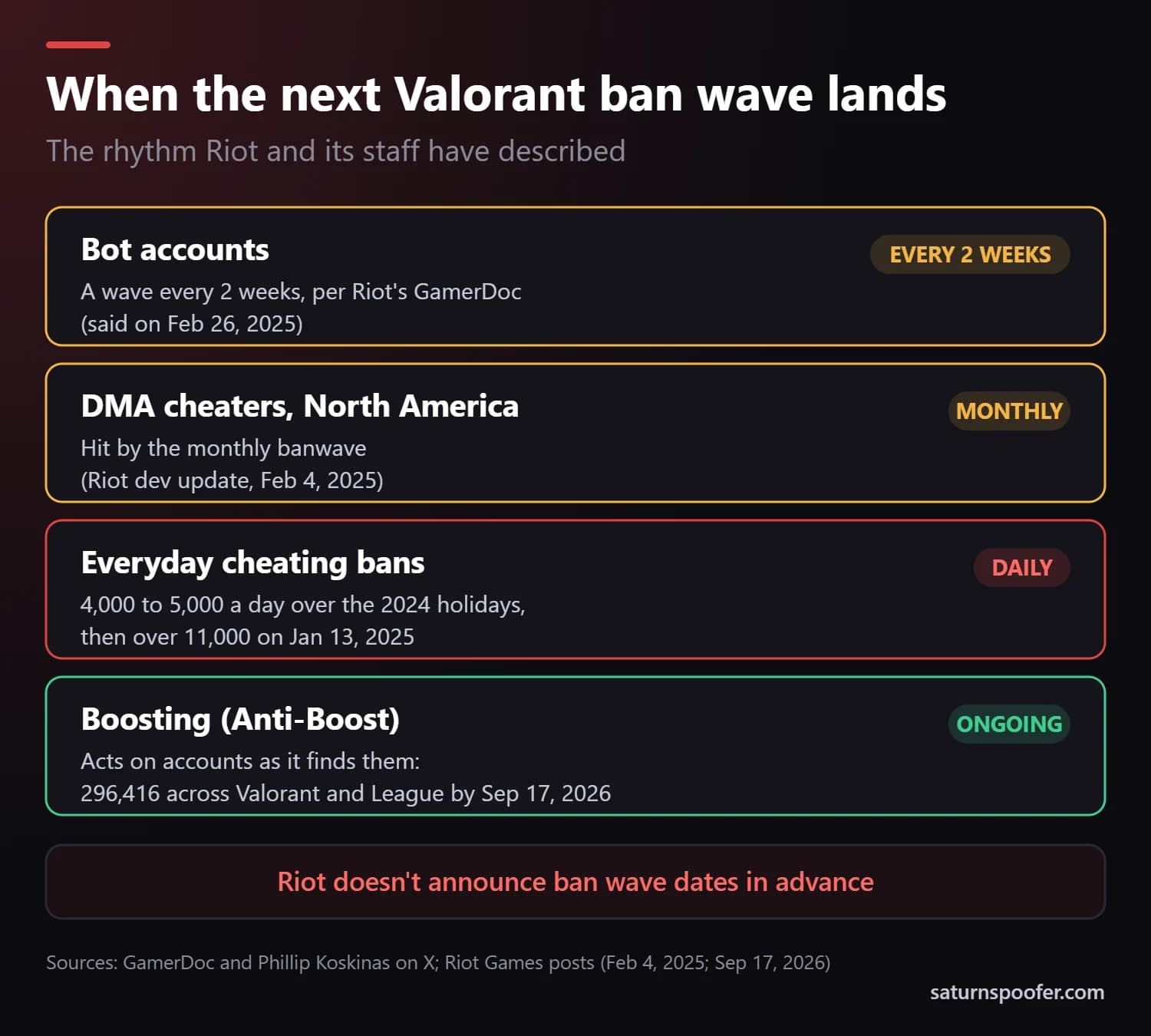
Riot doesn't publish Valorant ban wave dates, and every wave date it has shared came after the wave landed. Its staff have described a rhythm, though:
- Bot accounts: GamerDoc's February 26, 2025 post said Riot would run "a wave to ban bot accounts every 2 weeks" and HWID ban the bot farms it spots. We found no Riot update on whether that schedule still holds in 2026.
- DMA cheaters in North America: Koskinas's February 2025 update has them caught "with the monthly banwave."
- Everyday cheating bans: these don't wait for a wave. A chart Koskinas posted on January 13, 2025 shows about 4,000 to 5,000 cheating suspensions a day over the 2024 holidays, then more than 11,000 on January 13.
- Boosting: Anti-Boost acts on accounts as it finds them, and Riot plans to "crank the voltage on rank removal in the coming months."
Riot gives no warning before a wave. Players who suspect a quiet flag on their account in the meantime often call it a shadow ban. Reporting a cheater can bring news of the ban: Riot Vanguard said in July 2020 that reporters are notified if they're logged on, and the 2026 Playing Fair update added reporter and bystander feedback for rank manipulation penalties.
Who Gets Caught in a Valorant Ban Wave?
Valorant ban waves catch more than aimbot users. Riot's February 2025 update splits Vanguard bans into six sources:
- Manual: a ban placed by hand by a Vanguard specialist.
- Behavior: a machine learning suspension from Riot's server-side detection, often given to ragehackers.
- Hitchhiking: queuing with a cheater on purpose to gain rank.
- Cheating: an account caught with a specific cheat, usually after it slipped past a hardware suspension.
- Hardware: a repeat offender caught trying to beat Vanguard's hardware fingerprinting.
- Tampering: interfering with Vanguard itself.
Repeat offenders lead the count. Riot's winter 2023 anti-cheat update said players "using multiple accounts to cheat on the same machine" remain the majority of bans, and that machine is what hardware fingerprinting tracks.
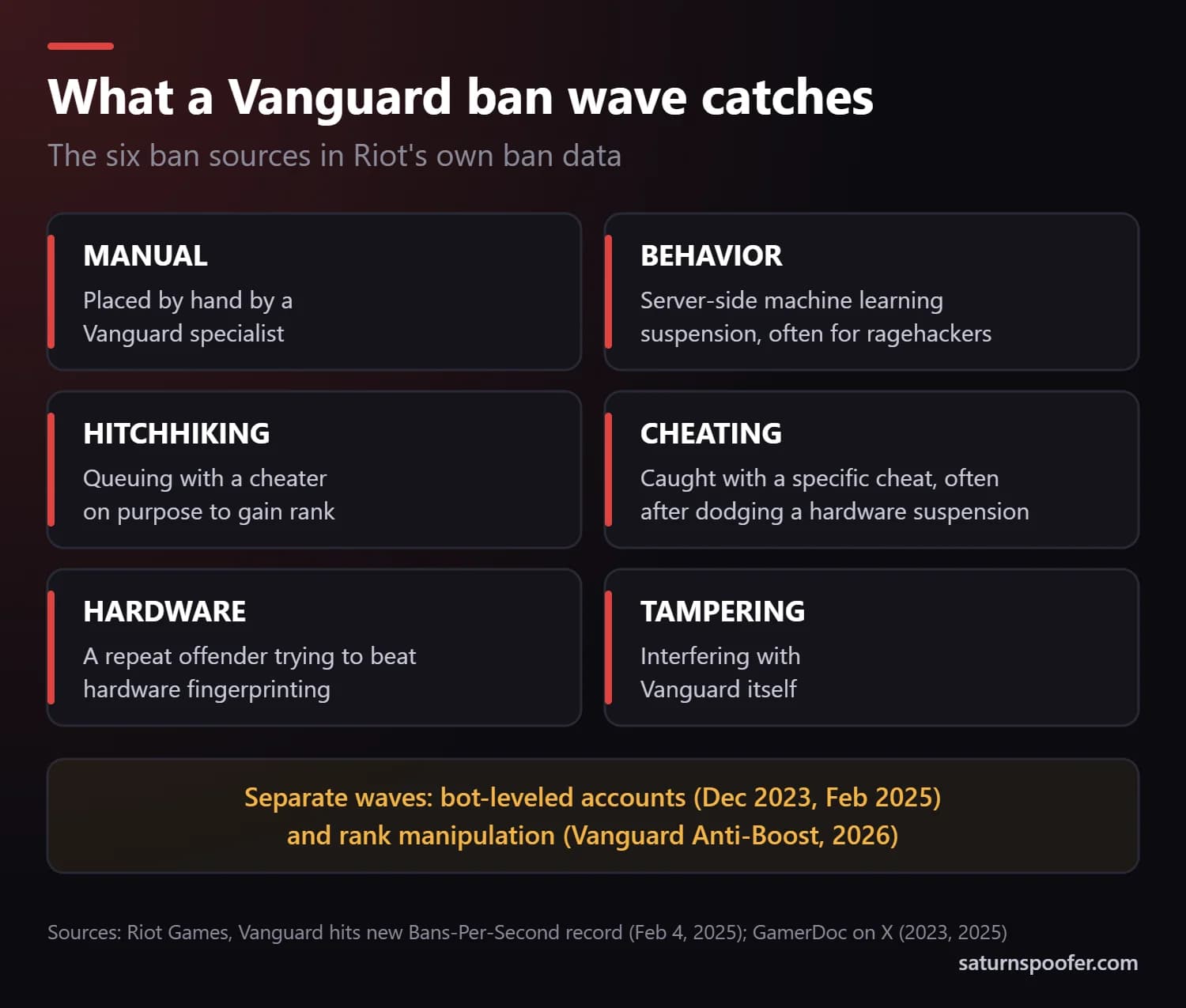
Two groups get waves of their own. Bot-leveled and bought accounts were GamerDoc's targets in December 2023 and February 2025, and the December 2023 lock screen read "Access to this game has been locked until 1/1/2203 8:00 AM." Boosters, the players they boost and their hitchhikers fall to Anti-Boost.
Third-party tools count too. Riot's user rules bar any unauthorized third-party program that touches its games, mods and bots included, which is why skin changers carry a ban risk.
What Does a Ban Wave Do to Your Account?
A Valorant ban wave's penalty depends on what it caught. These are the outcomes Riot and its staff have described:
- Cheating accounts: removed permanently, as Riot Vanguard put it in July 2020.
- Bot-leveled accounts: locked. The February 2025 screen says the account "has been permanently suspended" for using "prohibited third party tools."
- Queuing with cheaters: a 180-day ban since June 2022, when Riot Vanguard doubled it from 90 days.
- Boosting: rank removed and escalating suspensions, with bought accounts banned.
- Repeat offenders and bot farms: a hardware ID ban on the PC itself, shown as error VAN 152.
A hardware ban leaves two routes: ask Riot to review it, or have the PC present a different set of hardware IDs, which is what Saturn's Valorant HWID Spoofer does. Know the limits before you choose. A spoofer lifts nothing on Riot's side, every account Riot banned stays banned, and Riot's user rules forbid circumventing the measures it uses to control access. Start with the review.
How Valorant Ban Waves Differ by Region
Valorant ban waves follow each region's cheating habits. Riot's February 2025 update went through them one by one:
- Brazil: pixelbots, cheats that read the screen and move the aim. During Riot's holiday code freeze, Brazil briefly hit 10% of ranked games with a cheater.
- North America: costly DMA hardware setups, hit by the monthly banwave.
- Europe: kernel cheats that load through drivers signed with stolen or fraudulent certificates.
- Korea: national identity numbers are required for gaming, so Riot can ban cheaters at the "soul" level.
- Asia Pacific: cheaters from China use VPNs to dodge their local servers' ID rules, and Riot said it was working on geofencing for Vanguard services.
- Turkey: many PC cafes run cheats that are already installed. Cafes had been allowlisted through Riot's device ban layer, and Riot started revoking that immunity from repeat offenders.
- Latin America: pixelbots again, though Riot said it has little trouble catching them.
Caught in a Valorant Ban Wave by Mistake?
If a Valorant ban wave caught your account by mistake, request a review from Riot's Player Support team. The Terms of Service tell players who think Riot made a mistake to contact Player Support, and warn that the account may stay suspended while the case is reviewed.
Mistakes do get fixed. Riot's September 2024 update said 4% of VALORANT cheating bans are eventually reverted because the account had been compromised, and it warned that cheaters often make the same claim. Before you file:
- Find out which ban you have. Each ban type has its own route to a Valorant unban, and your login screen and error code show which type you have.
- Double-check the error code. A bug has the game showing wrong error codes, and Riot has flagged its own code list as outdated until it's fixed.
- Stick to facts in the ticket. Put the ban date, the error code and what was running on the PC into the Valorant appeal, and leave out guesses.
Player Support won't reverse a ban that fits the facts. If the account was bought, shared or run with a cheat, the ticket won't change the result: Riot's Terms of Service rule out selling, transferring or sharing an account (section 1.5).
Valorant Ban Wave FAQ
How long is a ban in Valorant?
A VALORANT game ban can run anywhere from 7 days to permanent in the penalty table Riot updated on June 2, 2026, while teamplay restrictions, which block team modes, last between 3 and 365 days. Cheating bans from a wave are normally permanent, and a VAN 152 hardware ban usually runs four months.
How long do VAN 152 bans last?
Usually four months. The VALORANT error code list on Riot's support site describes VAN 152 as an HWID ban that "typically lasts 4 months." That page carries a notice that it's out of date while a display bug is fixed, so ask Player Support if the code doesn't match what happened.
Can you get unbanned after a Valorant ban wave?
Yes, if the ban has an end date or was a mistake. Timed bans lift by themselves at the time shown, and Riot reviews bans it may have gotten wrong through Player Support. A confirmed cheating ban stays in place.
Do Valorant ban waves hit bought accounts?
Yes. Riot's bot waves in December 2023 and February 2025 targeted accounts that weren't leveled by hand, and Anti-Boost bans purchased accounts it catches in a boosting setup. Riot's Terms of Service forbid selling or transferring an account in the first place.
How many cheaters does Valorant have?
Riot said on June 24, 2026 that about 0.7% of ranked matches on PC have a cheater in them, counting League and VALORANT together. In February 2025, Riot put the share of ranked Valorant games with a cheater below 1% globally, after a holiday spike that briefly reached 10% in Brazil.
Does a VPN keep you out of a Valorant ban wave?
No. Riot's Valorant penalties land on accounts, and hardware bans land on PCs, so a new IP address doesn't move a ban. Riot's penalty table lists no Valorant IP ban in the first place.