 Gabri
Gabri
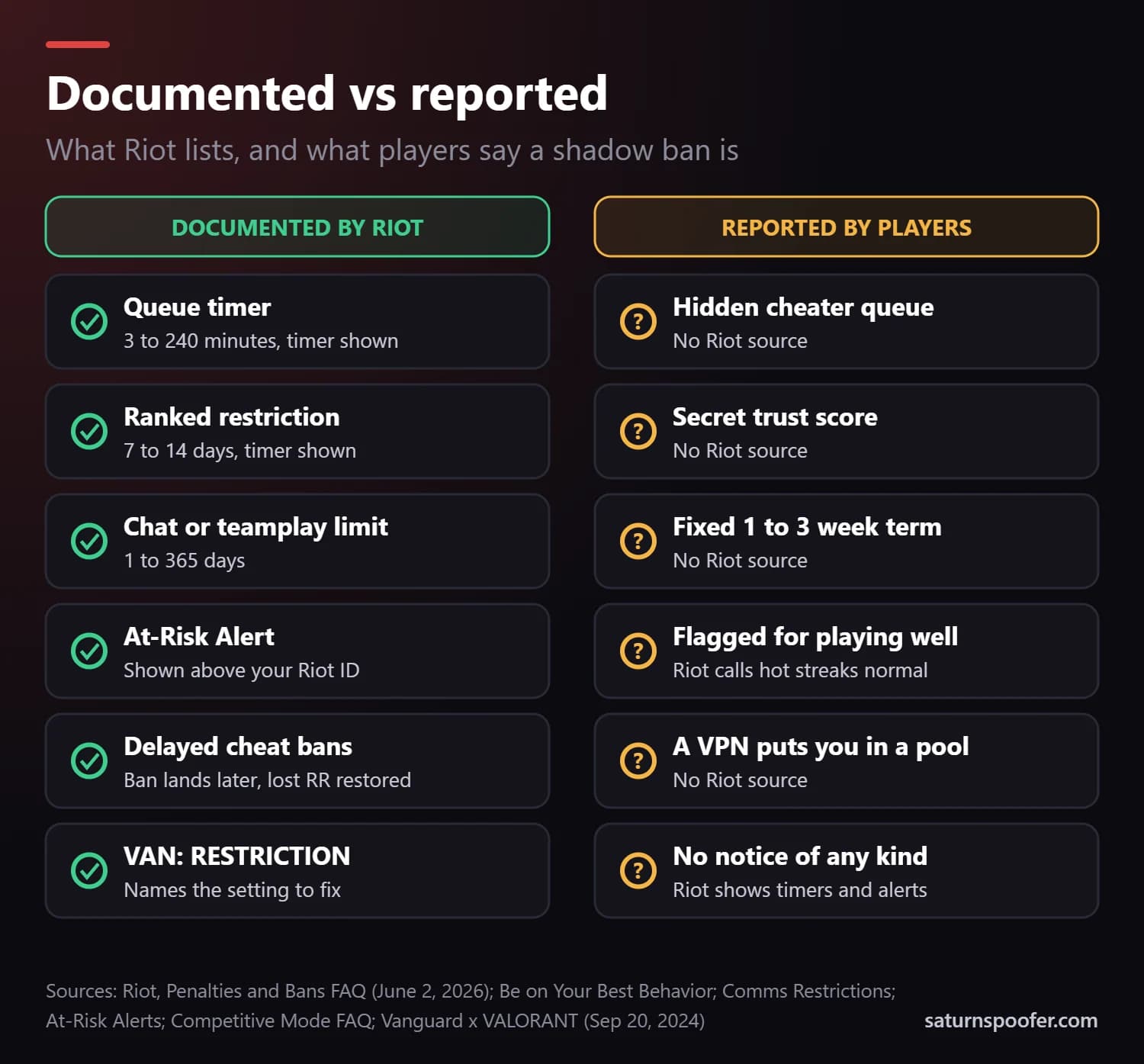
A Valorant shadow ban is a penalty players describe, not one Riot lists. Riot's VALORANT support pages, led by a Penalties and Bans FAQ that Riot last updated on June 2, 2026, name the penalties that touch matchmaking: queue timers of 3 to 240 minutes, ranked restrictions of 7 to 14 days, teamplay and chat restrictions, and game bans. Riot's tables say the timers and ban dates are shown to the player, and none of these penalties is described as hidden.
Riot does confirm something quieter. Its anti-cheat team wrote in September 2024 that it often waits before banning a cheater it has already detected, and in June 2026 it said cheaters show up in about 0.7% of ranked PC matches across League of Legends and VALORANT. Neither fact is a hidden queue, but each one feeds the stories players tell about one.
Does Valorant Have Shadow Bans?
No. Riot doesn't list a shadow ban among Valorant's penalties. Its VALORANT penalties catalog holds 13 articles, from At-Risk Alerts to the VAN: RESTRICTION errors, and none of them mentions a shadow ban, a hidden queue or a separate matchmaking pool.
Riot does restrict matchmaking, just in the open. Its Terms of Service, in the edition last modified on December 1, 2024, name "matchmaking queue bans and restrictions" among the steps Riot can take against rule breakers, and its VALORANT pages spell those steps out:
| Penalty | What it blocks | How long |
|---|---|---|
| Queue timer | Every game except customs | 3 to 240 minutes |
| Ranked restriction | Ranked matches | 7 to 14 days |
| Teamplay restriction | All but solo deathmatch and customs | 1 to 365 days |
| Comms restriction | Voice and text chat | 1 to 365 days |
| Game ban | Every mode | 1 day to permanent |
The queue timer and ranked restriction come from Riot's Be on Your Best Behavior page, where both last "until the timer shown runs out." The chat and teamplay lengths come from Riot's comms restrictions page and "may differ per region." You would notice every one of them. Riot's cross-game Community Pact adds a type called "Delays," a "delay of play for a period of time," which is the nearest thing to a slow queue in Riot's rules. It runs for a set period too.
What Players Call a Valorant Shadow Ban
A Valorant shadow ban, in the way players use the term, is a quiet penalty that drops a suspected account into slower queues and rougher lobbies without a word from Riot. The signs that come up in forum threads and blog posts look like this:
- Queues that suddenly drag. Matches that used to pop in under a minute take five minutes or more.
- Cheaters in game after game. One poster on VLR.gg said cheaters were in "50 to 60 percent" of their games and called it a cheater queue.
- Lobbies that make no sense. Wide rank gaps and brand-new accounts in the same match.
- No notice at all. No email, no error code and no timer.
- A run that lasts days or weeks. Some posts put a length of one to three weeks on it.
The frustration behind those posts is real. But none of the signs comes from Riot, and we found no Riot source for the theories built on them: a secret trust score, a fixed sentence, a pool for players who play too well. Riot keeps its detection private on purpose. Asked how infractions are detected, its penalty FAQ says "that information is only available on a need-to-know basis," which leaves plenty of room for guesswork.
Does Riot Delay Bans on Cheaters?
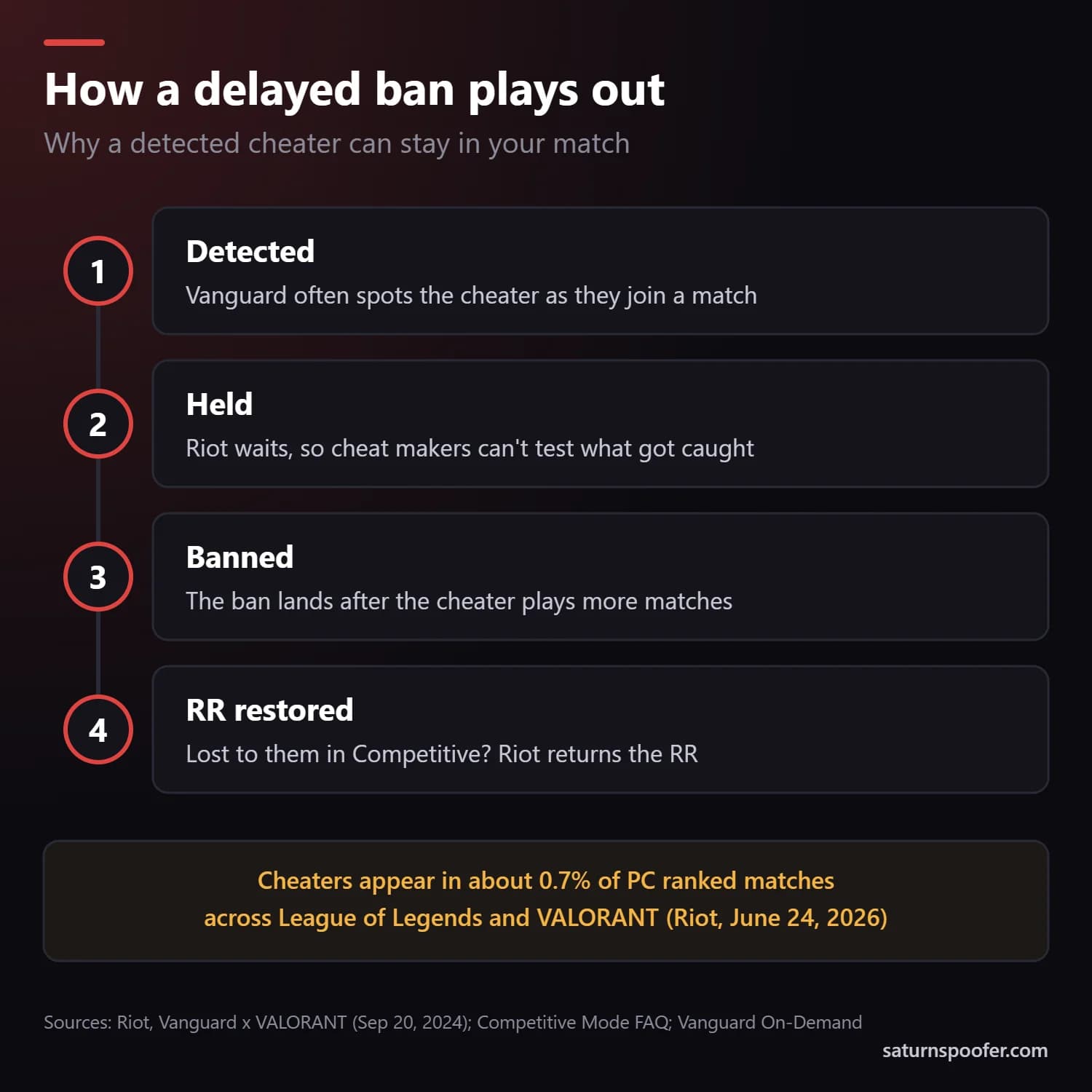
Yes. Riot's anti-cheat team has said it often detects a cheater as soon as they enter a Valorant match and holds the ban on purpose. In its Vanguard x VALORANT update of September 20, 2024, Riot explained that instant bans would let cheat developers A/B test its detections: change the cheat, make a new account and see what gets banned. Waiting "keeps our detection methods valid for longer."
Riot also admitted the cost: "a few players have to suffer at the hands of the cheater before the ban hammer strikes." That is the documented part of the shadow-ban story, and it runs backward from the rumor: the detected cheater keeps playing against ordinary players for a while, and Riot's description never mentions a separate queue for them.
Two more Riot measures fit the same picture:
- Vanguard Restrictions. When Riot sees "very suspicious activity" that stops short of clear cheating, the 2024 update says it can make the player turn on built-in Windows security features. The matching error on Riot's support site is VAN: RESTRICTION, which names the update or setting Vanguard wants, such as Secure Boot or TPM 2.0.
- RR restores. Riot's Competitive Mode FAQ says that if you lose to a confirmed cheater, Riot restores the lost RR when it bans them and sends you a notification, up to a limit per Act. The feature went live in Patch 10.05 in March 2025.
By September 2024, four years after Vanguard arrived with Valorant, Riot's ban count for cheating had passed 3.6 million accounts, about one every 37 seconds. Its June 24, 2026 anti-cheat update said cheaters "infect about 0.7% of all PC ranked matches" across League of Legends and VALORANT. That works out to about one ranked match in 140. Riot has also announced some of its cheating bans in bulk, as ban waves.
Why Your Matches Feel Like a Shadow Ban
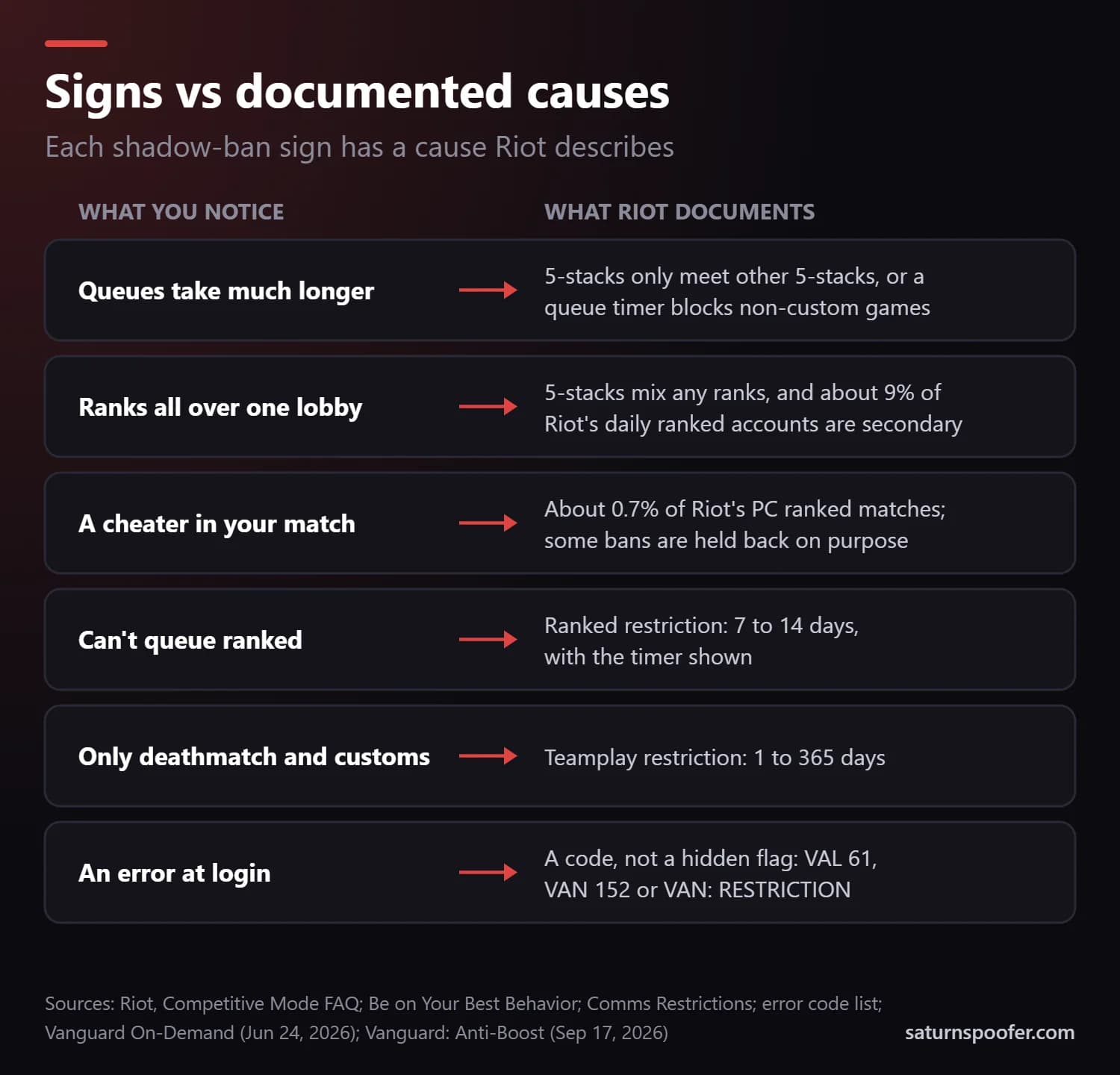
Each sign players pin on a Valorant shadow ban matches something Riot documents, and several of them can be checked from your own client:
- Long queues. Riot's Competitive Mode FAQ warns that groups of five "can expect increased queue times," because a 5-stack only meets other 5-stacks. A queue timer from an AFK or dodge penalty also keeps you out of every non-custom game until it expires.
- Ranks all over the place. A 5-stack has no rank limits, and Riot's own example is a team of three Irons and two Ascendants. Smurfs widen the gap: Riot's September 17, 2026 anti-boost update says about 9% of the accounts used in League and VALORANT ranked each day are secondary, and a player on an account that isn't theirs hides their real rating from matchmaking.
- Fresh accounts everywhere. The same update says over 70% of players have at least one alternate account. Riot's Community Pact allows owning several, as long as none is used to evade penalties or gain an edge.
- A cheater in your match. With a cheater in roughly 0.7% of ranked PC matches, meeting one is rare but not strange, and a delayed ban means a caught cheater can keep playing for a while.
- A losing streak. Riot's "Playing Fair" post counts a bad game, or a bad Act, as normal play, along with a streak of great matches.
- An error that doesn't fit. Riot says VALORANT is currently displaying incorrect error codes, so a VAL 5 error or any other code at login may not be the real one.
What Gets You a Real Valorant Penalty?
Riot's VALORANT pages tie penalties to four main behaviors: leaving or sabotaging matches, abusive comms, cheating, and rank manipulation. Each one leads to a penalty you can see:
- AFK, queue dodging and friendly fire. Warnings, lost XP, a loss of 6 to 24 RR, queue timers, ranked restrictions and, for repeat offenders, game bans.
- Abusive text or voice chat. A comms restriction comes first. Riot's comms page says a game ban follows only when a restricted player keeps using offensive language, and its September 22, 2026 "Playing with Respect" post says voice detection helped it penalize twice as many cases of voice abuse over the past year.
- Cheating. Riot's anti-cheat page says auto-clickers, aimbots and other unauthorized hardware or software get an account permanently banned, which covers every Valorant wallhack, ESP and aimbot cheat, software or hardware. Queueing with cheaters brings a 180-day ban. Since Patch 13.05 on September 1, 2026, stream-sniping and instalock tools earn temporary game bans that escalate to permanent with repeated use. Riot's HWID article also lists third-party tools among the causes of a hardware ID ban on the whole PC.
- Boosting and account sharing. Suspensions, rank and MMR reversions, and permanent bans for repeated, severe abuse.
Vanguard flags software in the open too. The VAN: Incompatible Software error names the driver or file it objects to, and a game run inside a virtual machine gets error 138. Riot Vanguard pairs a client with a kernel-mode driver that normally starts with Windows, though PCs that pass its Pre-Check can run it only while a Riot game is open.
How to Check Whether You're Restricted
You can rule out a real Valorant penalty by checking three places: the error code at login, any timer or end date in the client, and the space above your Riot ID where At-Risk Alerts and penalty details appear. Call it the three-place check. If all three are clear, none of the penalties in Riot's tables is running on your account. Work through it in this order:
- Read the code at login. VAL 61 is an account ban, VAN 152 a hardware ban, and a VAN: RESTRICTION error names a Windows update or security setting to fix. Riot's list says VAL 7 can mean a suspension, so check your email when you see it.
- Look for a timer or date. Queue, ranked and teamplay restrictions show a timer, and a game ban shows its end date and time.
- Look above your Riot ID. Riot's At-Risk Alerts show up there when an account nears a penalty, and an account that already has one can see "its details and duration."
- Report the cheater, not the queue. Report during the match with Esc, or afterward from Career, then Match History: right-click the name and choose Report. If Riot bans a cheater who cost you RR, you get a notification and the RR back.
- Ask Player Support. If something is wrong and none of the checks shows it, open a ticket the way you would for a Valorant ban appeal. Riot's Terms say it will review your case if you think it made an error.
One test to skip: opening a second account on your own PC to compare queues. Riot's HWID article says a different account that logs in on a machine under a hardware ban gets blocked there and banned for a set period of its own, because Riot treats that login as a way around the first ban.
When the Ban Hits Your PC Instead
A hardware ban is the one Valorant penalty that follows your PC instead of your account. Riot's HWID article says any login attempt under the ban returns the VAN 152 error, and any other account that player uses is suspended on sight. A Valorant hardware ban is temporary by default. On Riot's error code list, VAN 152 sits under "HWID ban," with the note that it "typically lasts 4 months." The ban isn't limited to Valorant, either: Riot's HWID article applies it to every Riot platform and game until it ends.
Saturn works as a Valorant spoofer: one loader that changes the hardware identifiers a PC reports, with your license deciding which anti-cheats it covers. Spoofing leaves the ban standing in Riot's records, and Riot's Terms bar getting around the technical measures that guard access to its games, so ask Riot for a re-evaluation first.
Valorant Shadow Ban FAQ
How long does a Valorant shadow ban last?
Riot gives no length for a Valorant shadow ban, because it doesn't list one. The timed penalties it does list run from a 3-minute queue timer to a permanent game ban, with the timer or ban date shown to the player. The one-to-three-week figures online come from players, not Riot.
How do I know if I'm shadow banned in Valorant?
You can't confirm a Valorant shadow ban, since Riot has no such penalty to show. You can rule out a real one: check for an error code at login, a timer or ban date in the client, and an alert above your Riot ID. If none of them shows anything, the timed penalties in Riot's tables aren't active on your account.
Is there a cheater queue in Valorant?
No Riot page we checked describes a cheater queue. Riot puts the share of ranked PC matches with a cheater at about 0.7% across League of Legends and VALORANT, and it sometimes delays the ban on a detected cheater, so one can stay in your games for a while. Queueing with a known cheater on purpose gets you banned for 180 days.
Can reports get you shadow banned?
No Riot page we read says reports send anyone to a hidden queue. Riot's Community Pact says reports are reviewed and penalties are issued when rules are broken, and the penalties it lists run from warnings and delays to suspensions and hardware bans. If many players report how you talk, Riot's advice is to dial it back.
Does a VPN get you shadow banned in Valorant?
No Riot page we read links a VPN to a shadow ban. Riot's fix for the VAN: Incompatible Software error does include turning off any VPN or proxy, since they can cause connection problems Riot calls impossible to resolve. Riot's penalty table doesn't list a Valorant IP ban at all.
How do I get out of a Valorant shadow ban?
Find the real penalty first, because that is the part you can fix. A timer or ban date ends on its own, a VAN: RESTRICTION error clears once you enable the setting it names, and a penalty you think is wrong goes to Player Support, where Riot reviews requests to get unbanned from Valorant.